
A commercial kitchen exhaust maintenance checklist only works when it splits tasks by interval and names the person responsible for each one. Daily filter checks belong to kitchen staff, weekly deep cleaning belongs to the kitchen manager, and hood, duct, and fan cleaning on an NFPA 96 based schedule belongs to a specialist. This article lays out those intervals, the record fields your log needs, the warning signs that your interval is too long, and the line between cleaning, inspection, and mechanical work that requires another trade. The result is a schedule you can hand to staff, post near the hood, and produce during a fire inspection.
Quick Reference: Intervals, Owners, and Record Fields
Use this table as the spine of your program. It maps each part of the system to a realistic owner, a starting interval, and the record field that proves the task happened.
| Component | Typical owner | Starting interval | Record field |
| Baffle filters | Opening or closing staff | Daily check | Date, initials, filter condition |
| Hood canopy and plenum | Kitchen manager | Weekly | Date, grease level noted |
| Duct interior | Specialist contractor | Monthly to annually | Photos, access points, zones cleaned |
| Exhaust fan and roof area | Specialist contractor | Same visit as ducts | Fan photos, grease level |
| Makeup air and HVAC filters | Facilities manager | Per equipment guidance | Filter change date |
| Log and reports | Kitchen manager | After every task | Business name, address, signoff |
What the Exhaust System Actually Includes
Grease does not stay in one place. It travels with hot vapor from the cooking surface up into the hood, through the filters, along the ducts, and out through the exhaust fan on the roof. Thin deposits settle on every surface along that path and build into a flammable layer over time.
Each component needs attention for its own reason:
- Hood: captures grease laden vapor and smoke directly above cooking equipment.
- Filters: trap the heaviest grease before it enters the duct run. A saturated or badly seated filter pushes grease deeper into the system.
- Ducts: carry the remaining vapor outside. Grease that coats the interior becomes fuel.
- Fan: pulls the whole system. A grease coated fan loses balance, moves less air, and can drip grease onto the roof.
- Makeup air and HVAC filters: replace the air the exhaust removes. Weak makeup air reduces hood capture.
Why the Schedule Matters More Than the Cleaning
Grease buildup inside kitchen hoods and ductwork is a leading cause of commercial kitchen fires in the United States. Cooking equipment is involved in more than 60 percent of restaurant fires according to the U.S. Fire Administration, and dirty exhaust systems are a major contributor. Grease reaches its flashpoint at roughly 600 degrees Fahrenheit, which sits well within the range of a flare up on a busy line.
A working schedule delivers three things at once. It improves ventilation for smoke and odor removal, it reduces fire risk, and it keeps the kitchen ready for inspection. Regular cleaning also supports proper airflow and fewer unexpected equipment problems. None of that happens if the work sits on a list that nobody owns.
How Often Should a Commercial Kitchen Exhaust Be Cleaned?
Published guidance points to the same range. NFPA 96 requires commercial kitchen hoods to be inspected and cleaned anywhere from monthly to annually, depending on cooking volume and the type of cooking. Duct cleaning follows the same logic, with monthly service for high volume operations and quarterly service for moderate volume kitchens. Some published schedules list options from once every four weeks through once every 12 months for canopies and exhaust systems.
The deciding variable is workload, not the size of the room. A kitchen running a deep fryer and a charbroiler through long service hours produces far more grease than a café warming pastries. Start with an interval that reflects actual cooking, then move it up or down based on what your cleaning reports show. A specialist who records grease levels at each visit gives you the evidence to justify the schedule.
Organizing Tasks by Interval
Daily Tasks for Kitchen Staff
Daily work is observation and quick correction, not deep cleaning. Keep it short enough that a busy closing shift will actually finish it.
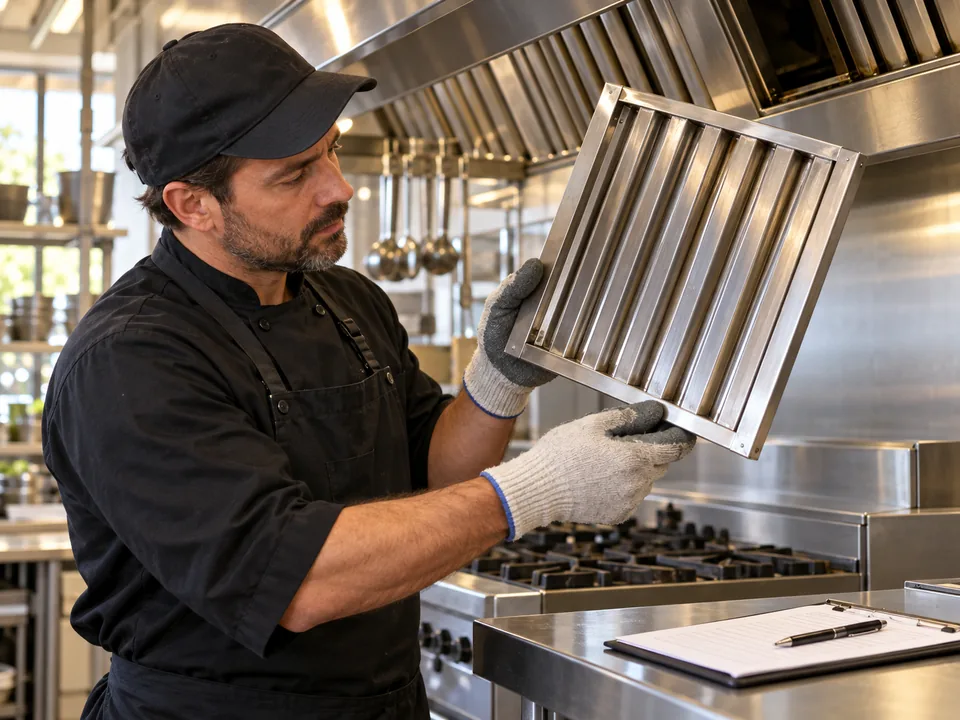
- Check that baffle filters are seated correctly and not loaded with grease.
- Flag any filter that clogs faster than the others.
- Wipe visible grease from hood surfaces, drip rails, and nearby walls.
- Watch how quickly smoke and cooking odors clear during service.
- Record the date, your initials, and anything unusual.
Weekly Deep Cleaning
Weekly work removes grease before it hardens and reaches places staff cannot easily reach later.
- Remove filters, clean them thoroughly, and let them dry before refitting.
- Degrease the hood canopy, plenum, and filter housing.
- Empty and clean drip cups and grease collection points.
- Inspect the filter bank for bent, missing, or damaged filters.
- Confirm the log entry is signed and any deficiency is flagged for follow up.
Monthly and Quarterly Checks
Monthly reviews look for trends, not just current condition. Ductwork assessment and fan condition are typical items at this interval, along with a review of the grease load your reports show.
- Inspect the ducts wherever access panels allow a visual check.
- Listen to the fan during service for unusual noise or vibration.
- Check the roof area for grease staining or drips around the fan.
- Confirm makeup air units and HVAC filters are working as expected.
- Compare this month’s grease note to the last one and adjust frequency if the trend is rising.
Professional Cleaning Intervals
Professional work covers the full path: hood, filters, plenum, ducts, and fan. A complete visit should include protection of the cooking area, cleaning of each zone, photos of what was found and what was cleaned, a list of deficiencies, the recommended frequency, and a signoff. That documentation is the part most kitchens cannot produce when an inspector asks for it. Professional cleaning is different from routine staff cleaning, and it is the piece that keeps the whole program credible, which is why kitchen exhaust system cleaning for restaurants is usually handled on a recurring contract rather than a one time call.
Assigning Responsible Roles
Unowned tasks do not get done. Name a person, not a department, for every line on the checklist, and name the person they escalate to when something looks wrong.
| Role | Owns | Escalates to |
| Opening or closing staff | Daily filter check and log entry | Kitchen manager |
| Kitchen manager | Weekly deep cleaning, log signoff | Facilities manager |
| Facilities manager | Scheduling, contractor access, records | Specialist contractor |
| Specialist contractor | Professional cleaning and reporting | Facilities manager |
| Qualified trade | Mechanical, electrical, or gas repairs | Facilities manager |
Keep a backup name for each role. When the closing lead is away, the schedule should not stop, because grease does not take a holiday.
Record Fields Your Log Should Capture
A maintenance log is only useful if someone else can read it months later and understand what happened. An exhaust hood maintenance log typically carries the business name and address, and notes that filters must be cleaned as often as necessary to stay in good operating condition. Build your own log around a consistent set of fields:
- Business name and kitchen address, so a report can be matched to the site.
- Date, time, and the name or initials of the person who did the work.
- Task performed and the zone covered, such as hood, filters, ducts, or fan.
- Observed grease level or condition, written in plain words.
- Photos for any professional visit, including access points and hard to reach areas.
- Deficiencies found, plus who was notified and when.
- Next scheduled service date and the recommended frequency.
- Signoff from the manager who accepted the work.
Store the log where staff can reach it and where an inspector can see it. A digital version with photos is easier to search, but a printed binder near the kitchen door works just as well if it actually gets filled in.
Warning Signs Your Interval Is Too Long
Frequency is not fixed. These signals mean the system is being cleaned less often than the kitchen needs.
- Smoke and odors linger longer than they used to during service.
- Filters load up faster than the schedule expects.
- Grease drips from the hood or appears on the cooking line.
- The fan sounds different, vibrates, or moves noticeably less air.
- Grease staining shows on the roof surface near the fan.
- Reports show grease accumulating in the same duct sections.
- Staff sign the log without performing the check.
Two or more of these are a reasonable trigger to move the professional interval up one step, then review again after a few cycles.
Cleaning, Inspection, Maintenance, and Mechanical Work
These four activities get blended together, and that causes confusion about who should be called.
Cleaning removes grease from the hood, filters, ducts, and fan. Inspection evaluates the condition of the system and reports what was found. Preventive maintenance covers routine care such as filter replacement, sealing, and access panel checks. Mechanical, electrical, and gas repairs on fan motors, belts, controls, or structural components belong to a qualified trade, not a cleaning crew. A good cleaning report tells the facilities manager what it found and who should look at it next, rather than quietly taking on work outside its scope.
Before hiring a provider, ask which current training, insurance, and trade qualifications apply to the work being performed. Requirements can vary by authority having jurisdiction in British Columbia, so confirm local rules with the fire prevention office or building authority.
Using the Downloadable Checklist
A download gives your team one page to work from instead of a paraphrased version of the program. A commercial kitchen hood and exhaust cleaning checklist typically covers daily staff tasks, weekly deep cleaning, professional cleaning on the NFPA 96 based schedule, setup, hood condition, duct condition, fan condition, photos, deficiencies, frequency, signoff, and the report itself.
Print one copy for the kitchen wall and keep one on file for the facilities manager. Review the whole document at least once a quarter against your actual reports, and update the intervals to match what the grease trend shows.
If you create a downloadable checklist for your site, give it a clear file name, date, and version number. Keep the current copy beside the log so staff always use the same steps, and replace older copies when the program changes.
Turning the Checklist Into a Recurring Schedule
The checklist only works if the professional interval is booked before the calendar fills up. Choose a starting frequency based on cooking volume, track grease levels across the first few visits, then adjust. If your facility spans several kitchens, keep one schedule per site so records stay attributable to the right address. Set up recurring service so the hood, filters, ducts, and fan are cleaned on a predictable cycle, documentation arrives after every visit, and your log stays current for inspections. That single step removes the most common failure point, which is remembering to book the next visit before the last one is forgotten.
Frequently Asked Questions
How often should a commercial kitchen exhaust system be cleaned?
Cleaning frequency follows cooking volume. NFPA 96 calls for hoods to be inspected and cleaned anywhere from monthly to annually, and duct cleaning follows the same logic, with monthly service for high volume kitchens and quarterly service for moderate volume operations. Lighter output kitchens may be able to stretch further, but the grease levels recorded in your reports should drive that decision rather than guesswork.
How often should hood filters be cleaned?
Filters should be cleaned as frequently as necessary to keep them in good operating condition, which in most busy kitchens means a daily check and a thorough wash at least weekly. If a filter looks loaded, feels heavy, or clogs faster than its neighbours, clean it sooner. Saturated filters push grease deeper into the ducts and reduce capture at the hood.
Who should be responsible for the maintenance checklist?
Split ownership by interval. Opening or closing staff handle the daily filter check, the kitchen manager owns weekly deep cleaning and log signoff, and the facilities manager schedules professional visits and keeps the records. Name a backup for each role so nothing stalls when someone is away. Unowned tasks are the most common reason a checklist quietly stops working.
What should be recorded after a professional cleaning?
Records should identify the business name and address, the date, the zones cleaned, the crew, the grease condition observed, photos of the hood, ducts, and fan, any deficiencies found, the recommended frequency, and a manager signoff. That package shows what was done, what still needs attention, and when the next visit is due, which is what an inspector or insurer is likely to ask for.
Can kitchen staff clean the ducts themselves?
Daily filter care and weekly surface cleaning are appropriate for trained staff. Duct interiors and the exhaust fan sit outside that scope. Reaching them safely requires access panels, containment, proper equipment, and roof work, and the cleaning has to reach surfaces staff cannot see. Professional cleaning is what produces the photographic record that supports the rest of your maintenance log.