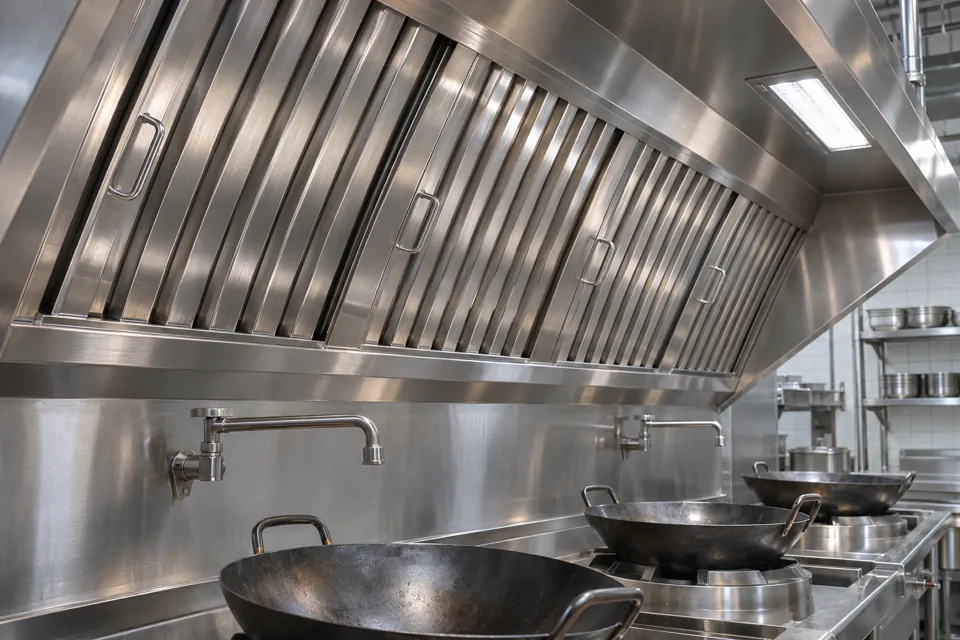
A wok line running flat out through a lunch and dinner rush pushes far more airborne grease into the exhaust system than a low-volume kitchen, so hood cleaning has to be planned as a full system job rather than a wipe down of the canopy. For owners and managers in Metro Vancouver, the practical answer is to schedule the work outside service hours, confirm the scope covers the hood, filters, plenum, ductwork and rooftop fan, and line up access before the crew arrives. The rest of this page covers how to plan each of those pieces so the cleaning actually matches the load your kitchen puts on the system.
| Area | What the cleaning should cover | What you prepare |
|---|---|---|
| Hood canopy and filter bank | Degreasing of the canopy interior, filter removal and filter cleaning | Clear the cooking line, remove personal items and small equipment |
| Plenum above the hood | Grease removal from the plenum space and the start of the ventilation pathway | Confirm the access point can be reached safely |
| Ductwork and ventilation pathway | Grease removal along the exhaust route, not just at the hood | Tell the provider about any known access panels or obstructions |
| Rooftop exhaust fan | Fan degreasing and rooftop access to the exhaust equipment | Arrange roof access, keys or building permission in advance |
| Scheduling | Work booked around your service windows | Pick a realistic downtime block and plan a backup menu |
How wok cooking affects grease load
Wok cooking concentrates heat and oil in a small area and repeats that cycle hundreds of times a service. Oil that leaves the wok as fine airborne mist cools as it rises, then settles on the hood interior, the filters, the plenum and the inside of the ductwork. Because the cooking never really stops during a rush, the deposit builds in layers rather than in one even coat, and the top of the hood and the plenum tend to load faster than the parts staff can see from the floor.
That load changes the job in two ways. First, it changes the time the cleaning takes. A hood that has been running at volume needs more dwell time on degreasing and more attention inside the plenum and along the duct run than a light-use canopy. Second, it changes how the work has to be accessed. Heavy grease on the upper surfaces and the fan means the crew needs room to work above the line, and that space has to be cleared before the visit, not during it.
Volume also affects how quickly filters reach the point where they stop doing their job. Filters that are saturated let more grease travel deeper into the system, which moves the work from the filter bank into the plenum and the duct. Filter cleaning is part of a proper commercial hood cleaning, but on a busy wok line it is worth treating filter condition as something the kitchen checks between visits. The question of how often the full system needs cleaning is a separate topic, covered in our existing frequency guide for wok and charbroiler operations. This page focuses on what the scope should include and how to plan the visit.
What the cleaning scope should cover
The most common gap in a wok kitchen is a scope that stops at the hood. Grease leaves the canopy and keeps travelling, so a quote that only describes the visible hood leaves the plenum, the ductwork and the rooftop fan carrying the load. Ask for the written scope to name each part of the system, and compare quotes on that basis rather than on the headline price.
Hood canopy and filters
The canopy interior, the filter bank and the surfaces around the cooking line should all be degreased, not just the stainless steel face that customers and staff see. Filters need to come out, be cleaned properly and go back in good condition. If a filter is bent, missing or no longer seating correctly, the cleaning visit is the right time to flag it, because a poor filter fit sends more grease downstream and shortens the life of the rest of the system.
Plenum and ductwork
The plenum is the space directly above the filters and it is where wok grease accumulates fastest. Cleaning should remove the deposit from the plenum surfaces and continue along the ventilation pathway so that grease is not left sitting in the duct run. Access matters here. If the duct has panels or openings that make the route reachable, the provider should know about them before the visit so the crew arrives with the right plan instead of improvising.
Rooftop fan and exhaust equipment
The exhaust fan is the end of the line and it takes a real share of the grease. Fan degreasing, along with the rooftop access needed to reach it, should be written into the scope. In Metro Vancouver this is often where a job stalls, because the fan sits on a roof shared with other tenants or controlled by a landlord or property manager. Sorting out roof access early keeps the cleaning on one visit instead of two.
Planning access and downtime
Scheduling is where most wok kitchen cleanings succeed or fail. The work needs room to move, and a line that is mid-service has neither the space nor the safety margin for it. Book a realistic window when the kitchen is closed or between services, then protect that window in the same way you would protect a delivery slot. If the kitchen cannot fully close, say so at the quoting stage so the provider can plan around it rather than discovering it on arrival.
Protection of equipment is a fair question to raise. Ask how the crew will reach the upper surfaces and whether they will need to stand on ovens, stoves or prep tables to get there. Most operators want a clear answer on this before anyone climbs, because a wok range that gets used as a step is a repair bill and a service interruption. Confirm what the crew brings for covering and protecting the line, and what you need to move beforehand.
Access is not only about the kitchen. Rooftop fan cleaning needs a route to the roof, and that route may involve a shared stairwell, a locked hatch or a building contact who is not on site at night. Give the provider the names and numbers they need, or arrange for someone from your team to be present. If the building has a property manager who coordinates roof access, loop them in early so the cleaning date does not slip.
Plan the service side as well. A cleaning block usually means a shortened menu, a late opening or a closed day, so brief front of house before the date is confirmed and decide who signs off the work when it is done. Larsa Vent Cleaning works with restaurants, cafés and commercial kitchens across Metro Vancouver and the Lower Mainland, including Vancouver, Burnaby, Richmond, Surrey, North Vancouver, West Vancouver, Coquitlam, Port Coquitlam, Port Moody, Langley, Maple Ridge, Pitt Meadows, Cloverdale, Mission, Abbotsford, Chilliwack, Squamish and Whistler, and the company focuses only on kitchen hood and exhaust systems rather than general HVAC or air duct work. That focus matters for a wok kitchen, because the whole job sits inside the exhaust route. You can review the commercial service details on our commercial kitchen hood cleaning page before you book.
Questions for the provider
A short list of questions before you confirm a date will tell you whether the provider understands a high-volume wok operation. Use the same list for every quote so the comparison is fair.
- Does the scope name the hood, filters, plenum, ductwork and rooftop fan separately, or does it describe only the canopy?
- How long will the work take on a wok line of our size, and what access do you need from us to hit that estimate?
- How will the crew reach and clean the plenum and the upper surfaces without standing on cooking equipment?
- Who arranges roof access for the exhaust fan, and what happens if the roof hatch is locked on the night?
- What protection is used around the cooking line, and what do we need to clear before you arrive?
- Will you flag damaged or badly fitting filters rather than just cleaning around them?
- How do you confirm the work is finished, and who signs off on site?
- Can the visit be scheduled outside our service hours without adding weeks of lead time?
Get the answers in writing with the quote. A provider who can be specific about plenum access, protection and the rooftop fan is usually the one who will finish the job in the window you have booked, and a written scope gives you something to check the finished work against.
Frequently Asked Questions
Does a wok restaurant need more than hood cleaning?
Yes. The hood is only the first part of the exhaust route. Grease from wok cooking travels past the filters into the plenum, along the ductwork and into the rooftop exhaust fan. A scope that covers only the canopy leaves most of the accumulated grease in place, so ask for the plenum, ductwork and fan to be included in writing.
Can the work be done while the kitchen is open?
It is difficult on a busy wok line because the crew needs space above and around the cooking equipment. Most operators book a closed day or a gap between services. If full closure is not possible, raise it at the quoting stage so the provider can plan access and timing around your service instead of arriving to find the line in use.
What should be protected before the cleaning crew arrives?
Clear personal items, small equipment and anything loose from the cooking line, and confirm which surfaces the crew may use for access. Ask the provider what covering and protection they bring for ovens, stoves and prep areas. Anything that cannot be moved should be pointed out before work starts, not after the crew has set up.
How do we coordinate rooftop fan cleaning with our landlord?
Treat roof access as a separate booking. Find out who controls the roof, whether keys or a fob are needed, and whether someone must be present. Share those details with the cleaning provider when you confirm the date. In shared buildings, looping in the property manager early is the simplest way to keep the whole job on one visit.
For a wok kitchen, the cleaning plan comes down to three things: writing a scope that follows the grease all the way to the rooftop fan, booking access and downtime before the date is locked in, and asking the questions that show whether the provider has handled a high-volume line before. Do those three and the visit becomes a scheduled maintenance task instead of a surprise. To book a window that fits your service hours, request a commercial hood cleaning quote and include your cooking volume, your line layout and your roof access details.
Request a commercial kitchen exhaust cleaning quote from Larsa Vent Cleaning.