Pizza restaurant hood cleaning is not the same job repeated at every address. A gas deck oven, a conveyor oven running from open to close, a wood-fired unit and a fryer station all push different material into the exhaust system, and each connects to the hood, duct and fan in its own way. Two pizzerias on the same street can need completely different scopes. The work starts by reading the cooking equipment and the pathway it feeds, then matching cleaning methods and access to what is actually installed.
Larsa Vent Cleaning works on kitchen hood and exhaust systems for restaurants across Metro Vancouver and the Lower Mainland, including pizzerias in Vancouver, Burnaby, Richmond, Surrey, Coquitlam, Langley and nearby cities. This article focuses on what makes a pizza kitchen different. The general component-by-component breakdown sits in our guide to kitchen exhaust system cleaning for restaurants.
Pizza exhaust systems at a glance
The table below is a starting point, not a diagnosis. Use it to think about which parts of your system carry the heaviest load before anyone quotes the work.
| Cooking equipment | What it adds to the system | What to check before scoping |
|---|---|---|
| Gas deck oven | Flour dust, baked-on film on nearby hood surfaces, moderate grease vapour | Whether the oven flue is separate from the hood capture area |
| Conveyor oven | Long, continuous heat and vapour output through the whole shift | Hood overhang and how much of the oven opening is actually captured |
| Wood-fired oven | Solid fuel exhaust carrying ash and soot alongside grease | Whether a dedicated duct path exists and where it terminates |
| Range and fryer station | The heaviest grease loading in the kitchen; filters load fastest here | Filter count, filter style and how often staff rotate them |
| Prep and finishing | Flour dust, cheese and topping debris that settles on filters and hood lips | Cleanability of surfaces under and around the hood |
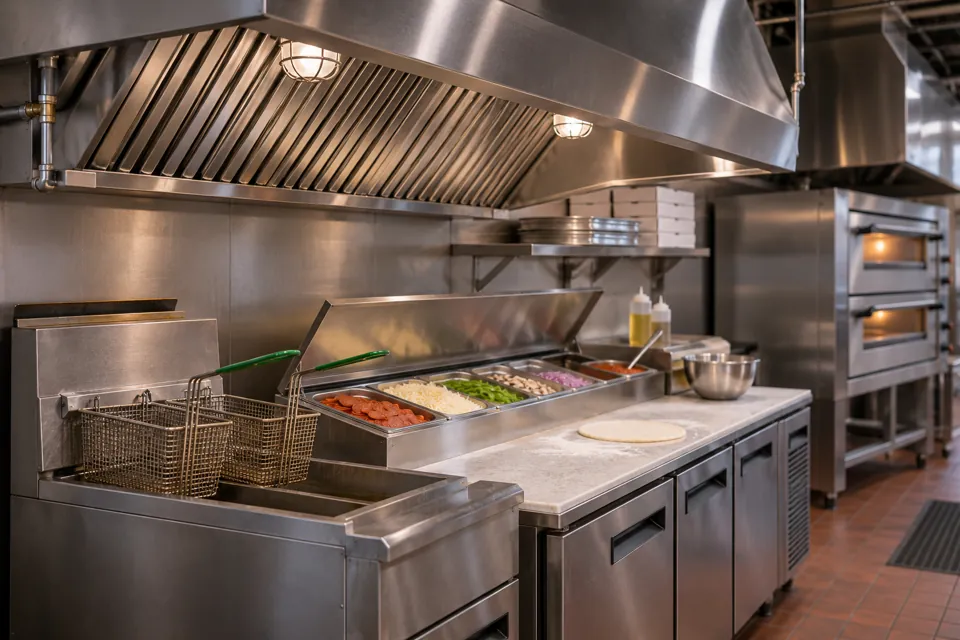
Which cooking equipment affects the exhaust
Deck ovens
A deck oven bakes at high heat for long stretches, and the hood above it collects a steady film of vapour and airborne flour. That film is lighter than what a fryer throws off, but it builds on hood interiors, filter frames and the roof of the capture area. Flour dust also settles into places that never see a visible flame, which is why a hood that looks acceptable from the floor can still be heavy with residue once panels come off. If the oven has its own flue running up through or beside the hood, confirm whether it is part of the same exhaust pathway or a separate one. Cleaning scope has to reflect the answer.
Conveyor ovens
Conveyor ovens rarely shut down mid-service, so the exhaust system works continuously rather than in bursts. Continuous heat and vapour production changes how quickly filters load and how much condensate forms on cooler duct surfaces. The other factor is geometry. A hood that only partially covers the oven opening will pull room air along with the exhaust, and areas outside the direct capture zone can collect residue that owners do not expect. Look at overhang, side panels and the seal between the oven and the hood before agreeing on scope.
Wood-fired ovens
Solid fuel changes the character of what travels through the duct. Ash and soot mix with grease, and that combination behaves differently from kitchen grease alone. A wood-fired oven often has a dedicated exhaust path with its own termination, and it may be built from materials that need different handling from a standard galvanised kitchen duct. Cleaning this kind of pathway requires the technician to know what the duct is made of and where it runs before any tooling goes in.
Range, fryer and prep stations
Most pizzerias also run a small hot line for wings, fries, sauces or pasta, plus a prep area for dough and toppings. These stations, not the oven, usually generate the heaviest grease loading. Filters accumulate grease and dirt quickly, and the duct downstream of that hood carries more oil than the oven side does. When the exhaust layout has one shared duct serving multiple hoods, the whole run has to be assessed as one system rather than as separate hoods.
Mapping hood, duct and fan
The hood and its filters
The hood is the visible part of the system and the part staff interact with daily. Filters are prone to grease build up, so they need routine removal and cleaning, and the hood interior behind them needs professional attention at a different interval. Approved degreasers are applied to hood surfaces, filters, ducts and fans, then high-pressure washing strips the loosened material. Low pH or high pH chemistry is chosen to suit the surface and the residue type rather than applied uniformly.
The duct run
This is the section owners cannot see and the section that carries fire risk. Grease buildup inside ductwork can ignite and spread fire rapidly through the system. Mapping means following the run from the hood collar, through any horizontal sections, around bends and risers, to the point where it exits the building. Every change of direction is a place where grease tends to collect and where access has to be created or confirmed.
The rooftop fan
The exhaust fan is the end of the pathway and often the greasiest single component. Fan cleaning involves removing accumulated grease from the housing, blades and surrounding curb area so the fan runs balanced and the discharge is clear. Roof access, safe anchoring and the fan type all determine how long this part of the visit takes.
Defining accessible areas
What access actually means
Access is not only whether a ladder reaches the roof. It covers whether duct panels can be opened, whether hinges and latches are functional, whether grease has sealed a panel shut, and whether there is room to work safely around the equipment. A pizza kitchen with a tight footprint and a low ceiling can be harder to service than a much larger room, because the same amount of work has to happen in less space.
Where access problems usually appear
- Duct sections boxed in above a finished ceiling with no opening.
- Fan units mounted where a technician cannot safely stand and work.
- Hood panels that were sealed rather than hinged during installation.
- Shared shafts serving a pizzeria and a neighbouring tenant.
- Wood-fired flues running through occupied spaces with no inspection point.
Where something cannot be reached, that should be documented rather than quietly skipped, so the owner knows which parts of the system were cleaned and which were not. Any question about required access or compliance should go to the local fire authority having jurisdiction, since requirements vary by municipality and by system type.
Planning a service visit
A service visit for a pizzeria is built around the equipment list and the pathway map, not around a standard package. The sequence usually looks like this.
- Confirm the equipment inventory, including oven type, hot line appliances and any solid fuel unit.
- Walk the full pathway from hood to rooftop fan and note every access point.
- Agree which components are in scope and which fall outside it because of access or construction limits.
- Set a service window that fits the pizza schedule, since a kitchen that closes late needs a start time that reflects that.
- Clean hood surfaces, filters, duct and fan with approved degreasers and high-pressure washing as suited to each component.
- Report on condition, flagging damaged panels, failing fan components or areas that need owner action.
Between professional visits, staff can keep the exterior of the hood and the filter bank in better condition with routine wiping and filter rotation, and a simple paste of baking soda and dish soap is a common manual option for surface film. That handles appearance. It does not reach the duct interior or the fan, which is why the professional scope has to cover the whole pathway rather than the visible hood alone. If you want the scope written for your specific system, request a system-specific quote and include your oven type and appliance list.
Frequently Asked Questions
How often does a pizza restaurant hood need cleaning?
There is no single interval that fits every pizzeria. Cleaning frequency depends on cooking volume, oven type, how much frying happens on the hot line, and the requirements your local fire authority applies to your system. A pizzeria running a fryer all day will generally load its filters and duct faster than one baking deck ovens only, so the schedule should be set after the system is assessed.
Does a wood-fired oven need a separate cleaning scope?
Usually yes. Solid fuel exhaust carries ash and soot alongside grease, and the duct materials may differ from a standard kitchen exhaust run. The pathway often terminates separately from the main hood fan. That means the wood-fired flue should be identified, mapped and quoted as its own component rather than assumed to be covered by standard hood cleaning.
Can the work be done while the pizzeria is closed?
Most pizza kitchens are serviced outside trading hours or in a window between service periods, since access to the hood, duct and roof is easier and there is no interference with food preparation. Scheduling depends on the size of the system and how much access exists. Share your closing time when you request a quote so the visit can be planned around it.
Do filters get cleaned as part of the service?
Filters are part of the visible system and are prone to grease and dirt accumulation, so they are included in the cleaning scope and handled with approved degreasers. Many operators also rotate and clean filters in house between professional visits. Confirm which party is responsible for the filter bank at each stage so nothing is missed between scheduled cleanings.