If smoke pools under the hood instead of disappearing into it, your exhaust system is not moving enough air, and the fix depends on which part of the chain has failed. In most Metro Vancouver restaurant kitchens, the cause comes down to a small list: clogged filters, grease buildup in the duct run, restricted makeup air, negative air pressure, a weak or undersized exhaust fan, a control fault, or a mechanical fan breakdown. This guide gives you a quick symptom table, then walks through eight problems grouped by what actually fixes them: cleaning, airflow balance, controls, and repair. It also shows where cleaning work ends and where a technician or mechanical contractor has to take over.
Quick symptom check before you call anyone
Watch what happens during a busy service rather than in a quiet kitchen. Most symptoms point fairly clearly at one part of the system.
| Symptom | Most likely cause | Category |
| Smoke rolls out from under the hood | Clogged filters or grease buildup | Cleaning |
| Strong pull at one end of the hood only | Airflow imbalance | Airflow balance |
| Doors are hard to open, smoke drifts into the dining room | Negative pressure, weak makeup air | Airflow balance |
| Fan runs but suction feels weak | Grease on the fan, or an undersized fan | Cleaning or airflow |
| Fan will not start, or stops during service | Belt, motor, or control fault | Repair or controls |
| Kitchen stays hot and hazy all shift | System cannot move enough air overall | Airflow balance |
Why a hood stops pulling smoke
A commercial hood system is a chain: the hood and filters, the duct run, the exhaust fan on the roof or wall, and a makeup air supply that replaces the air being pushed outside. If any link is restricted, the whole chain underperforms, even when the fan itself is running.
Balanced airflow is the idea that holds the system together. A hood requires balanced airflow, and if the makeup air supply is restricted or blocked, the hood cannot exhaust effectively no matter how strong the exhaust fan is. That is why swapping or speeding up a fan rarely solves a smoke problem on its own.
Industry guidance notes that restaurant systems exhausting at or greater than 800 cfm often make sense to pair with a makeup air unit interlocked with the exhaust. If your system was built that way, a fault in that setup will show up as smoke in the kitchen rather than as an obvious mechanical failure.
Cleaning issues: rule out grease first
Cleaning problems are the most common and the cheapest to correct, so they belong at the top of the list.
1. Clogged hood filters
Grease-laden filters restrict the air the hood can capture. Look for filters that are visibly coated, dripping, or heavy, and for smoke that curls along the underside of the hood instead of rising into it. Clogged filters seriously reduce airflow, and filter condition changes within a single week in a high-volume kitchen. This is the first thing to check, and often the first thing to fix.
2. Grease buildup in the duct run
Ducts carry grease-laden air away from the hood, and over time that grease collects on the inside walls. As deposits build, the pathway narrows and airflow drops. Blocked ductwork also raises fire risk because the grease itself is the fuel. Cleaning the hood opening alone does not address this. The full duct run has to be cleaned, not just the parts you can reach from the kitchen floor.
3. Grease on the exhaust fan
The fan is the last place grease collects and one of the most damaging. Heavy deposits on the blades and housing reduce the fan’s ability to move air and put extra load on the motor. A rooftop fan that looks black with grease, or that sounds strained, is a cleaning problem before it becomes a repair problem. Exhaust fan cleaning is part of routine system maintenance, not an optional extra.
Airflow balance issues: the air has nowhere to go
When the exhaust side is clean but smoke still lingers, the problem usually sits on the supply side of the equation.
4. Restricted or missing makeup air
Every cubic foot of air pushed out of the building has to be replaced. If the makeup air supply is blocked, switched off, or undersized, the hood cannot exhaust effectively. Check the intake path for obstructions, confirm the makeup air unit actually runs when the exhaust runs, and confirm filters on that unit are not loaded. A closed or blocked intake, or a unit that has quietly stopped, produces the same smoke symptoms as a dirty hood.
5. Negative pressure and airflow imbalance
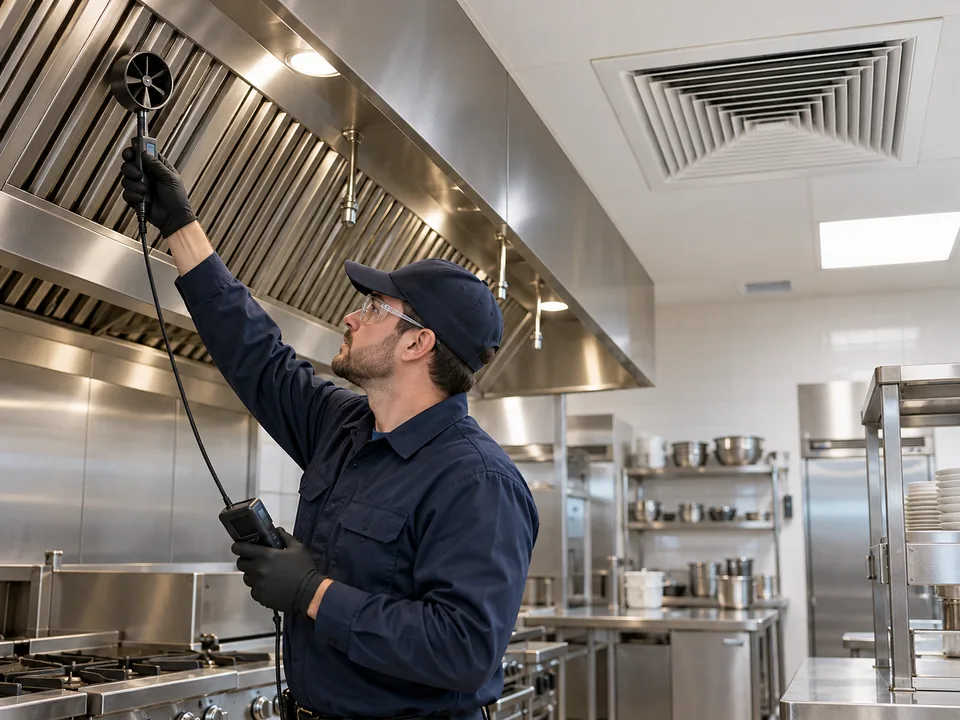
Negative pressure builds when the building exhausts more air than it brings in. The signs are familiar: doors that are hard to pull open, smoke drifting out into the dining room, and a hood that seems to lose capture as the shift gets busier. The kitchen is essentially competing with the rest of the building for air. Airflow imbalance is a balance problem, so it needs measurement, not guesswork.
6. Weak or undersized exhaust fan
Sometimes the fan is clean and running, but it simply moves less air than the hood needs. This is common with undersized or weak exhaust fans, and with hoods that were sized for a lighter cooking load than the kitchen now runs. If the system was adequate before a menu change, added cooking equipment, or a renovation, the exhaust side may now be the limiting factor. Poor hood sizing and insufficient exhaust airflow are design issues, not cleaning issues.
Control issues: the system is not being told to run
7. Fan controls, interlocks, and speed settings
Exhaust systems do not always fail mechanically. They can fail at the control layer: a fan speed setting changed by accident, an interlock that no longer switches the makeup air on with the exhaust, or a control that shows the fan as running when it is not. On a system built with a makeup air unit interlocked to the exhaust, a broken interlock lets the exhaust run starved of replacement air. Control faults are diagnosed, not cleaned.
Repair issues: mechanical failures cleaning cannot fix
8. Fan belts, motors, and fan failure
When a restaurant exhaust hood is not pulling smoke or steam, the cause is usually a fan failure, a belt issue, grease buildup, or an airflow problem. A worn or slipping belt, a motor that runs hot or trips, or a fan that does not turn at all will all stop smoke from leaving the kitchen. Grease-related belt and motor problems are common because deposits add load. These are mechanical repairs, and they sit outside the scope of cleaning work.
Technician-reviewed diagnostic table
The table below is the working version of the eight problems, arranged so a technician can mark off each item during an inspection and record what was actually found.
| Problem | Category | What gets checked | Fix path |
| Clogged filters | Cleaning | Grease load, airflow at the hood face | Filter cleaning schedule |
| Duct grease buildup | Cleaning | Full duct run, access points | Full system cleaning |
| Fan grease | Cleaning | Blades, housing, rooftop components | Exhaust fan cleaning |
| Makeup air restricted | Airflow balance | Intake path, unit operation, filters | Balance and repair |
| Negative pressure | Airflow balance | Building pressure, door pull | Airflow measurement |
| Weak or undersized fan | Airflow balance | Air moved against hood requirement | Fan or design review |
| Control or interlock fault | Controls | Sequence, speed settings, interlocks | Controls technician |
| Belt or motor failure | Repair | Belt condition, motor, fan rotation | Mechanical repair |
A technician can record measured airflow or static pressure, observed grease levels, and the condition of belts and motors during a site inspection. Those findings depend on the equipment and should be interpreted against the system design and the technician’s measurements.
Where cleaning stops and mechanical work begins
Knowing the boundary saves you time and money. Cleaning work covers removing grease from filters, hood surfaces, the duct run, and the exhaust fan. Inspection and maintenance work covers confirming that the system moves the air it was designed to move and reporting what has changed. Mechanical and controls work covers belts, motors, fan assemblies, speed settings, interlocks, and any repair or redesign of the exhaust or makeup air equipment. Electrical work belongs with a qualified tradesperson.
Routine cleaning frequency and any compliance requirements are set by the authority having jurisdiction and often by your insurer as well, so confirm your own schedule with them rather than relying on a general rule. Detailed work in depth also needs a clear report of what was cleaned or found, which supports your readiness for safety inspections.
First steps for Metro Vancouver restaurant managers
During service, do three things: confirm the filters are in place and not loaded with grease, step outside and listen for the fan, and watch where the smoke goes when the kitchen is busiest. Note when the problem started. A sudden change after a power interruption points at controls or the fan. A gradual decline over weeks points at grease and filters. A problem that only appears at peak cooking points at airflow balance and makeup air.
If filters, filters and duct condition, and fan operation all look reasonable and the kitchen still fills with smoke, the next step is measurement rather than more cleaning. Book a diagnostic inspection so the airflow, the makeup air supply, and the mechanical and control components are assessed together. That inspection also tells you whether your next step is a scheduled kitchen exhaust system cleaning for restaurants, a mechanical repair, or a balance adjustment.
Frequently Asked Questions
Can I fix a smoky kitchen just by washing the filters?
Sometimes, if the filters are the only restriction and grease has not built up deeper in the system. Filter washing restores airflow at the hood face, but it does nothing for grease inside the duct run or on the exhaust fan. If smoke returns within a few days of clean filters, the restriction is further down the system and needs a closer look.
How do I know if makeup air is the problem?
Look for signs of negative pressure: doors that are hard to open, smoke drifting out of the cooking area into the dining room, and a hood that loses capture as cooking picks up. Then check whether the makeup air unit runs whenever the exhaust runs, and whether its intake path is clear. Confirming the actual balance needs measurement.
How often should a restaurant exhaust system be cleaned?
Frequency depends on your cooking volume, the type of cooking, and the equipment you run, and it is normally set by the authority having jurisdiction and your insurer. Confirm your required schedule with them directly. High-volume frying and charbroiling kitchens generally need more frequent cleaning than light preparation kitchens, so your own operating pattern matters more than a general number.
What should I do next if the smoke does not clear up?
Work through the eight items in order: filters, ducts, fan condition, makeup air, building pressure, fan capacity, controls, and mechanical parts. If the kitchen still fills with smoke after cleaning, stop guessing and get the system measured. Book a diagnostic inspection so you know whether the next step is cleaning, a repair, or an airflow correction.