The practical starting point for any commercial kitchen in British Columbia is simple: your exhaust system is covered by two overlapping rulebooks. BC Fire Code kitchen exhaust cleaning duties begin with Division B, Section 2.6.1.3, which states that hoods, ducts, and filters subject to accumulations of combustible deposits must be inspected at intervals not greater than 7 days and cleaned when the buildup creates a fire hazard. NFPA 96, Standard for Ventilation Control and Fire Protection of Commercial Cooking Operations, then sets the benchmark for how often that cleaning should happen, usually between monthly and annually depending on cooking volume. This article explains the difference between those two requirements, clarifies local enforcement across BC municipalities, and shows owners and facility managers how to build an effective fire prevention routine.
One more point before the details: the BC Fire Code and NFPA 96 are separate documents, and NFPA 96 does not replace the provincial Fire Code. Equipment that meets NFPA 96 can still fail a fire inspection if grease has been allowed to build up, and a spotless filter bank does not prove that the duct and fan are clean. Read this as general information, not legal advice, and confirm the exact edition and any local amendments with your fire department or building official.
The two rulebooks behind BC Fire Code kitchen exhaust cleaning
Commercial kitchen operators hear NFPA 96 discussed constantly, but enforcement in BC actually flows through provincial and local documents. The BC Fire Code is the code enforced at the provincial level in British Columbia, while NFPA 96 is a technical standard published by the National Fire Protection Association. Many BC municipalities use NFPA 96 when reviewing kitchen ventilation designs, which means the two documents work as a pair rather than as competing authorities.
The table shows how the pieces fit. The BC Fire Code row is the everyday legal floor in BC. The NFPA 96 row is the professional standard that most inspectors and cleaning companies use to size the cleaning schedule. The final two rows reflect the reality that permit approval and site enforcement depend on your municipality and its appointed officials.
What the BC Fire Code requires from commercial kitchens
Section 2.6.1.3 under the service equipment requirements of Division B is direct. It applies to hoods, ducts, and filters subject to accumulations of combustible deposits, and it creates two separate duties. The first duty is inspection at intervals not greater than 7 days. The second duty is cleaning when the accumulation of deposits creates a fire hazard.
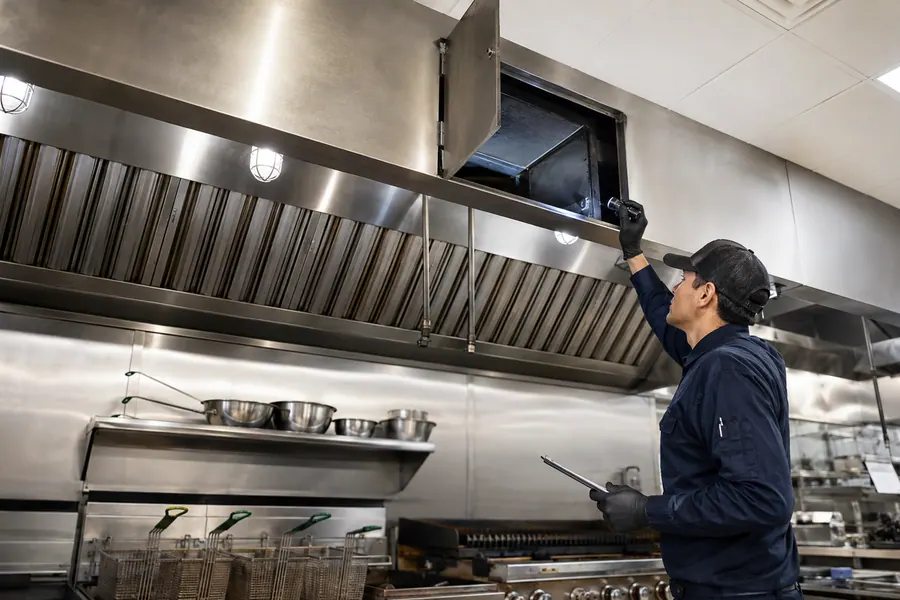
The weekly inspection is not the same as a professional deep cleaning. A kitchen operator, shift lead, or manager can perform a visual check of the hood surface, the filters, and any visible section of duct that collects grease. The purpose is to catch buildup before it reaches a level that presents a fire risk. The cleaning requirement is separate: once deposits create a fire hazard, cleaning is required, and that cleaning should be handled by a provider trained to remove grease from the entire exhaust pathway.
Making the 7-day inspection practical
For most kitchens, schedule the inspection on the same day each week and write down the result. Look for continuous grease coating on the underside of the hood, clogged filter surfaces, and visible residue around duct access points. If the buildup is light, normal cleaning can continue. If the buildup is heavy enough to be an obvious hazard, do not wait for the next scheduled professional visit. Arrange cleaning before the next cooking shift.
NFPA 96: The standard behind commercial kitchen hood requirements
When inspectors or permit reviewers discuss commercial kitchen hood requirements, their first reference is usually NFPA 96. The standard establishes requirements for commercial cooking operations and covers the exhaust system from the hood through the ductwork to the fan. NFPA 96 requires commercial kitchen hoods to be inspected and cleaned anywhere from monthly to annually, depending on cooking volume and the type of cooking being done.
The reason the range is wide is that kitchens differ. A café that heats pre-made food does not produce the same grease load as a wok station, a charbroiler line, or a wood-fired pizza operation. NFPA 96 connects cleaning frequency to actual cooking load, which is why an inspector may expect different intervals for two restaurants that look similar from the outside.
NFPA 96 2025 updates that affect cleaning schedules
The 2025 revision of NFPA 96 tightens the schedule for two groups. Systems that serve solid fuel cooking, such as wood or charcoal, and systems that operate more than 16 hours a day may now require monthly cleanings. If either description fits your business, your cleaning schedule should reflect that higher frequency rather than a generic quarterly visit. Confirm the current NFPA edition and any local amendment with your AHJ before updating your maintenance contract.
Provincial, municipal, and permit requirements in BC
The BC Fire Code provides the provincial baseline, but municipalities add their own requirements through building permits and business approvals. Restaurants, cafés, and businesses with commercial kitchens need city-approved kitchen ventilation and fire protection systems to safely remove grease-laden vapors. That approval process usually begins before construction or a tenant improvement, and it includes a review of the exhaust system design.
The City of Coquitlam offers a clear example. Its Commercial Cooking Exhaust Systems Guide tells applicants that cooking equipment used in processes that produce smoke or grease-laden vapors must be equipped with an exhaust system that complies with the equipment and performance standards of NFPA 96. A municipality does not need to adopt NFPA 96 word for word to make it part of the local process. It can reference the standard as a condition of permit approval, which is what many BC communities do.
Type I hoods and automatic fire protection
Fire protection expectations also follow the type of cooking equipment. Under model fire code language found in the 2024 International Fire Code, each required commercial kitchen exhaust hood and duct system that must have a Type I hood must be protected with an approved automatic fire extinguishing system. BC does not rely on the International Fire Code as its provincial code, but similar expectations can appear in municipal bylaws, insurance conditions, or facility requirements. A building official or fire protection designer can confirm whether your equipment falls into the Type I category and what suppression system applies.
Who enforces the BC Fire Code and NFPA 96
The authority having jurisdiction, or AHJ, is normally the local fire department, building inspector, or regional safety official. The AHJ enforces the BC Fire Code and any local bylaws that apply to your site. For a new location, the AHJ reviews drawings before work begins. For an operating kitchen, the AHJ may inspect after a complaint, after an incident, during a permit renewal, or as part of a routine fire safety check.
When an inspector visits, the condition of the hood, filters, ducts, and fan area matters more than the name of your cleaning company. If grease is visibly heavy, the response is likely to be an order to clean the system and prove that it was done properly. Good record keeping gives you a defensible answer. Keep dates of professional cleaning, notes from your 7-day inspections, and any recommendations made by your cleaning provider.
Cleaning by an approved company
Fire code language in several jurisdictions goes beyond telling you to clean. Model provisions such as Section 609.5.3.3 of the International Fire Code state that the commercial cooking exhaust system, including the hood, ducts, and devices, must be cleaned by an approved cleaning company. The practical effect is that self-cleaning of a few filters may not satisfy an inspector if the ductwork and fan remain greasy. Use a provider that documents the full system, not just the visible hood surfaces.
How to choose a professional cleaning schedule
Your cleaning schedule should be based on the conditions NFPA 96 uses to set frequency, plus any direction from your local AHJ. Consider these factors when deciding how many cleanings to book each year:
Cooking type. Solid fuel cooking, charbroiling, wok cooking, and frying produce heavier grease loads than baking, steaming, or reheating.
Daily operating hours. Kitchens running more than 16 hours per day now fall into the monthly cleaning category under the NFPA 96 2025 revision.
Meal volume and production peaks. A busy weekend kitchen may need a shorter interval than a low-volume establishment with similar equipment.
Your own 7-day inspection findings. If grease is accumulating faster than expected, shorten the professional interval.
AHJ expectations. A fire official or building inspector can tell you what they expect to see in your cleaning records.
The NFPA range of monthly to annually is wide enough that two kitchens with the same hood style can have different schedules. The goal is to choose an interval that keeps grease from reaching a hazardous level before the next cleaning.
Cleaning, inspection, repair, and mechanical work are different tasks
A professional kitchen exhaust cleaning removes grease from hood surfaces, grease removal devices, ducts, and fans. Inspection confirms the current condition of those surfaces. Repairs and mechanical upgrades are separate categories of work. A cleaner may point out a damaged fan, a missing access panel, disconnected ductwork, or a suppression system that has discharged, but fixing those issues belongs to the appropriate licensed trade.
Understanding that boundary helps owners avoid two common mistakes. The first mistake is treating a visual inspection as a full cleaning. The second is assuming that cleaning can fix a design flaw or a damaged component. Grease removal is fire prevention and maintenance. Structural, electrical, and suppression work requires different qualifications and often a permit.
Warning signs that grease buildup is ahead of schedule
Some signs are easy to spot during a busy service and should not wait for the next scheduled cleaning:
Grease is visible as a continuous coating on the underside of the hood.
Filters look shiny, clogged, or are dripping even after routine washing.
Residue is visible around duct access panels or on the roof near the exhaust fan.
Air movement feels weaker than it used to when the exhaust system is running.
Grease odors linger in the kitchen even when cooking has stopped.
If any of these descriptions match your system, move the cleaning date forward and have the full exhaust pathway assessed.
Primary sources to review before you set your schedule
None of the guidance above replaces reading the primary documents or confirming the current edition with your local authority. The following sources support the points in this article and are worth keeping on file:
BC Fire Code, Division B, Section 2.6.1.3, Service Equipment. This is the provincial text covering hoods, ducts, and filters and the 7-day inspection interval.
NFPA 96, Standard for Ventilation Control and Fire Protection of Commercial Cooking Operations. This is the standard behind monthly-to-annual cleaning intervals, including the 2025 revision for solid fuel cooking and operations over 16 hours per day.
City of Coquitlam, Commercial Cooking Exhaust Systems Guide. This guide reflects how a BC municipality applies NFPA 96 to building permit drawing requirements.
International Fire Code, Sections 609.5.3.3 and 904.2.2. These model code provisions address exhaust system cleaning by an approved company and automatic fire protection for Type I hoods.
Before publication, verify the applicable editions with your fire department, building official, or qualified cleaning contractor. Local amendments can change how a standard applies to your building.
Frequently Asked Questions
These are the questions owners ask most often when they compare provincial rules with NFPA guidance and local inspection expectations.
Does the BC Fire Code require professional kitchen exhaust cleaning?
The BC Fire Code does not use the phrase "professional," but it does require hoods, ducts, and filters to be inspected at intervals not greater than 7 days and cleaned if combustible deposits create a fire hazard. The professional cleaning frequency, usually monthly to annually, comes from NFPA 96 and depends on your cooking volume and type. Many BC municipalities and fire officials expect a documented cleaning schedule based on that standard.
How often do commercial kitchen hoods need to be cleaned in BC?
NFPA 96, which many BC municipalities use to judge commercial kitchen exhaust systems, requires hoods to be inspected and cleaned anywhere from monthly to annually depending on cooking volume and type. Under the 2025 revision, systems that serve solid fuel cooking or operate more than 16 hours a day may require monthly cleanings. Your local authority having jurisdiction can confirm which interval applies to your specific operation.
Is NFPA 96 a law in British Columbia?
NFPA 96 is a technical standard published by the National Fire Protection Association, not a BC statute. The BC Fire Code is the provincial regulation. NFPA 96 becomes a legal requirement when a local government, building official, or fire authority adopts or references it. Many BC municipalities reference NFPA 96 for commercial cooking exhaust systems, so in practice most commercial kitchens must meet the standard.
What is a Type I hood?
Type I hoods are used where cooking produces smoke or grease-laden vapors. When a Type I hood is required, model fire code provisions such as Section 904.2.2 of the International Fire Code state that the hood and duct system must be protected by an approved automatic fire extinguishing system. A local building official, mechanical designer, or fire protection contractor can confirm whether your equipment requires a Type I hood.
Put your compliance schedule into action
Start with the 7-day check that the BC Fire Code already obligates you to perform. Use it to spot visible grease before it becomes a fire hazard. Then align a professional full-system cleaning schedule to NFPA 96 and to the volume of cooking your kitchen handles. Keep cleaning records in one place so you can show a consistent maintenance history when questions arise.
Owners and facility managers in Metro Vancouver and the Lower Mainland can simplify this process by working with a provider that treats exhaust cleaning as a fire safety task. Larsa Vent Cleaning provides commercial kitchen hood cleaning for restaurants, cafés, and food service facilities, with service designed around the requirements discussed above.
If it has been several months since your last professional service, or if you are not sure whether your current reports would support an inspection, the practical next step is clear. Book a compliance-focused inspection, have the system assessed from the hood to the rooftop fan, and use the findings to build a cleaning schedule that fits your actual cooking load. A documented inspection gives you a defensible maintenance plan and a clearer picture of your kitchen's fire safety position.
For more about the company serving Vancouver and Metro Vancouver, visit Larsa Vent Cleaning.