
Grease leaking from a rooftop exhaust fan usually points to one of three things: failed seals around the fan and its curb, an exhaust stream that is still carrying grease vapour as it leaves the fan, or a grease containment system that has filled up, degraded, or was never installed. The practical takeaway is that a roof grease leak rarely stops on its own, and the damage it causes to roofing material can become permanent well before anyone notices the stain from ground level. This article covers where grease escapes, how it damages the roof membrane, what containment is supposed to do, why fan access matters, and when cleaning is no longer enough and repair is required. It is written for restaurant owners and landlords in BC who need to decide what to do next.
Before spending money on anything, separate the two problems: the grease sitting on the roof right now, and the source that keeps putting it there. Cleaning the roof area without fixing the source, or fixing the source without addressing saturated roofing material, tends to produce the same phone call again a few months later.
Quick Reference: What the Symptom Usually Means
Use this table to match what you are seeing on the roof to the most likely cause and the sensible next step. It is a starting point for a conversation with your exhaust cleaning provider or roofing contractor, not a diagnosis from a distance.
| What you see | Likely cause | Urgency | Sensible next step |
| Grease streaks near the fan curb | Improper seals at fan joints, heavy use, bad weather | Medium | Inspect fan and seals, clean the area |
| Pooling grease spreading across the roof | Dirty hood filters, dirty rooftop fan, no working containment | High | Containment check, fan cleaning, roof review |
| Blistered, swollen or cracked membrane | Long term grease saturation | High | Roofing assessment before more cleaning |
| Grease running during or after rain | Rain flushing accumulated grease, bad seal at the fan | Medium to high | Containment and seal review |
| Dry roof, clean containment pan | System working as intended | Low | Keep the cleaning schedule |
Where the Grease Actually Comes From
Grease does not stop at the hood. Cooking vapours travel through the exhaust duct, and a portion of that grease-laden vapour condenses as it cools on the way out. Even when the internal exhaust system is cleaned properly, vapour can still make it through the fan and condense outside on the roof. That is the part many operators miss: a perfectly clean duct does not guarantee a clean roof.
The main escape pathways are consistent:
- Around the fan and its curb, where seals and joints sit exposed to weather and repeated heat cycles.
- Through the fan itself, when the fan is grease-loaded and throws material outward as it spins.
- Past hood filters that are dirty, damaged, or wrong for the cooking load, which lets more grease into the duct in the first place.
- Off the roof surface during rain, when pooled grease is washed away from the fan area and across the membrane.
Improper sealing around fan joints can allow grease to leak onto the roof, especially during heavy use or bad weather. Rain between service days, ageing seals, and a fan that has never been cleaned internally all make the same leak worse over time.
Why Roof Grease Becomes Roof Damage
Roof grease is not just unsightly. As the grease saturates the roof, it causes irreversible blistering, swelling, and cracking of roof materials. It can also weaken the hold of the seams that bind the roofing material together. Once the membrane reaches that stage, cleaning will not reverse it. Grease on a rooftop leads to costly repairs, and no matter what your roof is made of, grease will eventually damage it.
The risks extend beyond the roofing bill:
- Fire risk, because pooled grease on a roof is a combustible material sitting above an operating kitchen.
- Slip and fall danger for maintenance, inspection, and service crews walking the roof.
- Structural and waterproofing problems that grow quietly under a layer of grease.
- Environmental concerns, since grease runoff can leave the roof and enter drainage systems.
For landlords in BC, this matters because roof repair costs and roofing warranty disputes are rarely covered by a tenant’s kitchen habits. For restaurant owners, it matters because the same grease that damages the roof is the grease that feeds a duct fire.
Grease Containment: Purpose, Failure Points and Lifecycle
Rooftop grease containment systems exist to catch grease before it spreads. They are essential for preventing grease from kitchen exhaust fans from damaging rooftops, creating fire hazards, and polluting the surrounding environment. A working system catches what the fan throws and what the roof sheds, and holds it where it can be serviced.
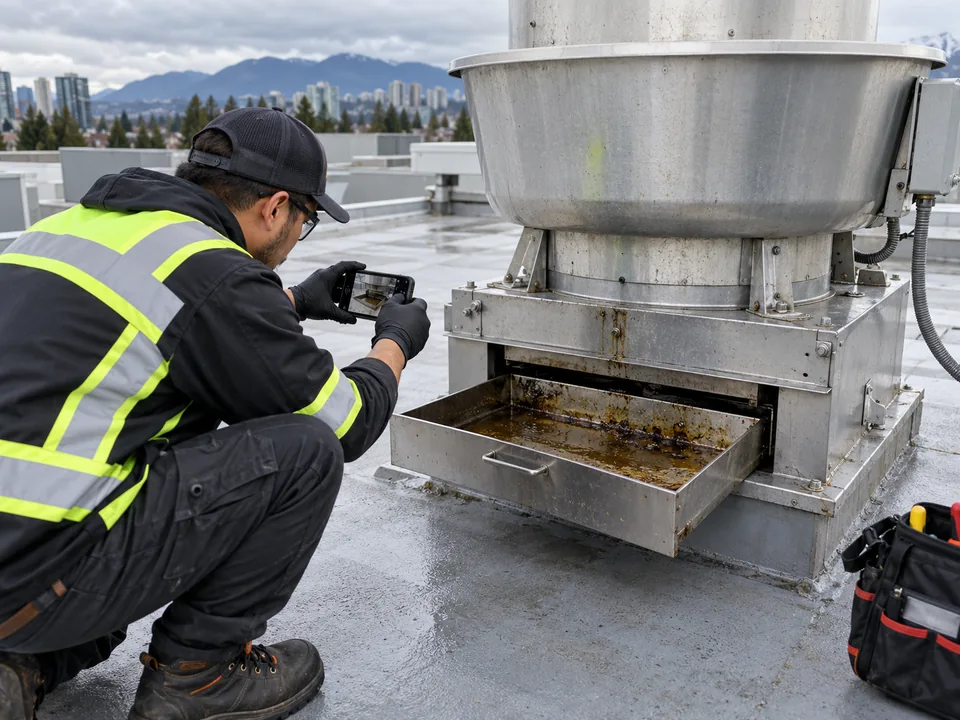
Containment fails in predictable ways. Pans fill and overflow. Absorbent media becomes saturated and stops absorbing. Units are damaged by wind, snow, or foot traffic. Some roofs never had containment installed, and some have hardware that has simply reached the end of its useful life. Containment systems have a lifecycle, and there comes a point where replacement or upgrade makes more sense than another round of patching.
Every containment style needs a service routine matched to the cooking volume. A high-output kitchen producing heavy grease loads will fill a containment unit far faster than a café doing light breakfast service. If nobody is checking it between scheduled visits, the first sign of trouble is usually a stain on the membrane.
Fan Access: Why the Leak Is Hard to See From the Ground
Rooftop exhaust fans are usually the least visible part of the system from inside the restaurant, which is exactly why they get neglected. Access matters for two reasons. First, a fan cannot be cleaned properly without safe, adequate access to the unit, its housing, and the curb it sits on. Second, the evidence of a leak, such as grease trails, staining, and standing pools, only shows up when someone is actually standing on the roof looking at the right area.
Fan access also affects safety. Grease on walkways, ladder points, and roof edges turns a routine service visit into a hazard. Any inspection should include the path to the fan, not just the fan itself.
Cleaning, Inspection, Maintenance and Repair: Knowing Which One You Need
These four activities get blended together in conversation, and that causes operators to buy the wrong thing. Fan cleaning removes accumulated grease from the fan and its housing. Inspection identifies what condition the fan, seals, containment, and roof area are in. Maintenance covers consumables and small adjustments, such as replacing containment media or reseating hardware. Repair is mechanical or roofing work: failed bearings, damaged fan components, deteriorated seals that need replacement, or roofing material that has already been compromised.
A cleaning crew should be clear about where its scope ends. Cleaning is not roofing work and is not a substitute for a roofing contractor’s assessment when the membrane has already failed. Equally, a roofing contractor will not remove grease from inside an exhaust fan. Where local fire code requirements apply to your exhaust system, confirm the specifics with your local fire authority rather than relying on a general rule of thumb.
When Repair Is Required
Cleaning and containment servicing handle most grease complaints. Repair becomes the correct answer when the problem is physical rather than accumulative. The clearest triggers:
- The roof membrane is already blistering, swollen, or cracked, which means the damage is past the point where cleaning helps.
- Seals at the fan joints are deteriorated and cannot be restored by cleaning alone.
- The containment unit is broken, undersized for the cooking load, or has reached the end of its serviceable life.
- The fan itself has mechanical problems, which belong with a qualified mechanical technician.
- Grease is entering the building or pooling in a location where it creates an immediate fire or slip hazard.
In each case, the sequence matters. Stop the source, contain what the fan throws, then address the roof. Repairing the roof first, while the fan keeps discharging grease, simply resets the clock on the same damage.
Warning Signs Worth Checking on Your Own Roof
You do not need to diagnose anything, but a quick look from a safe vantage point can tell you whether to call now or wait for the next scheduled service. Look for dark streaks running from the fan curb across the membrane, standing grease around the base of the fan, containment pans that are full or holding water, damaged or missing absorbent media, and any softness or bubbling in the roof surface near the fan. None of these require you to climb onto the roof. If access is unsafe or the roof is wet, leave it to a trained crew.
Photos of the Roof and Fan Area
Photographs are the fastest way to show a landlord, a property manager, or a roofing contractor what is happening above the ceiling. They also create a record of condition before and after work, which protects everyone if a dispute comes up later.
For a useful record, photograph the fan and curb, any grease trails, the containment unit and its fill level, and visible changes to the roof membrane. Add the date and location to each image. Stay in a safe area and leave close inspection of a wet or damaged roof to a trained crew.
Keeping Grease Off the Roof Long Term
Prevention comes down to a few habits that are cheap compared to roof repair. Keep hood filters clean and correctly fitted so less grease enters the duct. Clean the rooftop fan on a schedule that matches your cooking volume, not a calendar convenience. Service containment units before they overflow rather than after. Watch the roof after heavy rain, since that is when accumulated grease travels furthest. And keep a written record of every service, because a documented history of exhaust system and containment care is useful evidence when a landlord, insurer, or inspector asks questions.
Grease leaking from a rooftop exhaust fan is a maintenance signal, not a mystery. The fix is usually a combination of fan cleaning, containment that actually works, and honest advice about whether the roof itself needs a professional assessment. Our restaurant exhaust fan cleaning service covers the fan, housing, and grease removal that sits behind most rooftop leaks.
Next Step: Request Fan and Roof-Area Inspection
If you are seeing grease on the roof, the practical next step is a combined look at the fan and the roof area around it, so the source and the damage are assessed together rather than guessed at separately. Request fan and roof-area inspection and you will get a clear picture of what is clogged, what is leaking, what is holding grease, and what needs a different trade to fix it. Larsa Vent Cleaning works with restaurants, cafés, commercial kitchens, and property managers across Metro Vancouver and the Lower Mainland.
Frequently Asked Questions
Does grease on the roof mean my exhaust system was cleaned badly?
Not necessarily. Even a properly cleaned internal exhaust system can still release grease-laden vapour that condenses outside on the roof. Grease on the roof is often the result of dirty hood filters, a grease-loaded rooftop fan, failed seals at the fan joints, or a containment system that is full or missing. The only way to know is to look at the fan and roof area directly.
How fast can grease damage a commercial roof?
It depends on cooking volume, how much grease reaches the roof, and how often it happens. As grease saturates the roof, it causes irreversible blistering, swelling, and cracking, and it can weaken the seams that hold roofing material together. Because the damage is progressive rather than instant, catching it early is what keeps a maintenance issue from becoming a roofing project.
Can I just clean the roof and leave the fan alone?
You can, but the grease will return. Cleaning the roof surface without addressing the fan, its seals, and the containment unit removes the symptom and leaves the source in place. The usual result is the same stain reappearing after the next heavy cooking period or the next stretch of rain, which costs more in the long run than fixing both together.
What is the difference between grease containment and fan cleaning?
Fan cleaning removes accumulated grease from inside the fan and its housing. Grease containment captures the grease that escapes the system and lands on the roof, holding it where it can be serviced. Both are needed. Cleaning reduces what leaves the fan, and containment handles what still gets through, which is why they are usually serviced on the same visit.
Who should I call first, a cleaner or a roofer?
Start with the exhaust side so the source of the grease is addressed. If the roof membrane is already blistering, swollen, or cracked, cleaning will not reverse that, and a roofing assessment is needed as well. Requesting fan and roof-area inspection first gives you photos and a condition record you can hand to a landlord or roofing contractor.