
If grease from your kitchen exhaust fan is landing on the roof, you need containment. That is the short answer. A rooftop grease containment system catches and absorbs the fats, oil and grease that leave the fan before they reach the roof surface, which protects the roof from damage and reduces a real fire hazard. A grease box, an absorbent pillow or pan, and a fan hinge kit are the pieces that usually do that work.
The longer answer depends on your building. Menu, cooking volume, fan size, roof membrane, curb clearance, and how the fan is opened for cleaning all change the recommendation. This article explains what these systems do, how to maintain them, what failure looks like, and how to check whether a hinge kit or containment box will even fit your fan. It also marks the point where cleaning stops and mechanical or roofing work begins, which matters for restaurant owners and property managers across BC.
Quick Reference: Situations, Causes, and Next Steps
Use this table to place your building. Each row describes a common situation on a Lower Mainland commercial roof.
| What you see | What it usually means | Practical next step |
| Grease staining near the fan | Fan is discharging FOG onto the membrane | Photograph it and book a roof-area assessment |
| No hinge kit on the fan | Fan is hard to open and may be damaged during cleaning | Check for 2 to 3 inches of clearance at the curb |
| Media saturated or missing | Pillow or pan has stopped catching grease | Schedule cleaning and media replacement |
| Grease on conduit or roof edges | Discharge is spreading beyond the fan curb | Ask whether a 360 degree design fits your fan |
| Box does not match the fan | Parts may not fit without modification | Confirm fan make, model, and wheel size first |
What an Exhaust Fan Grease Containment System Does
Exhaust fan grease containment is a simple idea with a specific job. Cooking produces fats, oil and grease, commonly shortened to FOG, and a rooftop fan discharges some of it outside. Without something in the way, that grease settles onto the roof surface.
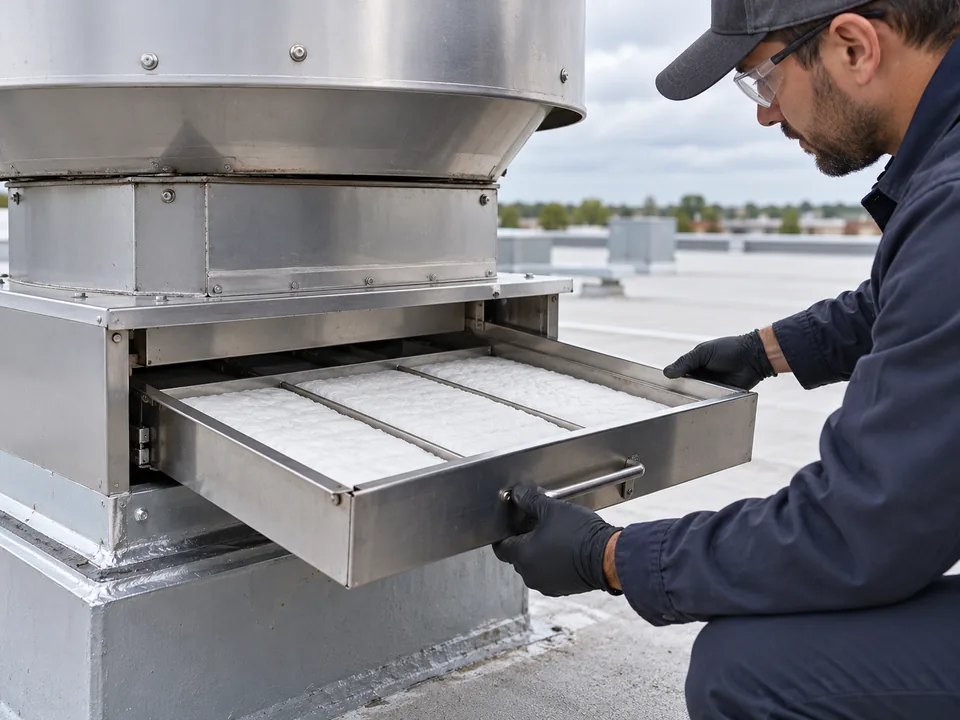
Multi-tiered grease collection units for rooftop kitchen exhaust fans catch and absorb grease and oils before they land, which protects rooftops from damage or fire. Grease boxes do the same work on a smaller scale, using a grease-absorbent pillow or pan to collect oil before it reaches the roof. Product documentation for these boxes describes them as preventing membrane damage and supporting NFPA and EPA compliance.
The failure mode is quiet. Nothing leaks inside the building, so nobody notices until the roof shows staining, the membrane softens, or a technician lifts a saturated pillow out of a box full of old grease.
The Parts of a Rooftop Containment Setup
- Containment unit: a multi-tiered collection unit or gutter-style system that surrounds the fan. Some designs provide 360 degree protection around the exhaust fan.
- Grease box or cup: a smaller unit mounted to the fan or curb. One example built for kitchen-duty centrifugal exhaust fans measures 17-1/8 inches long, 5-1/16 inches wide, and 3-3/4 inches high in 18 gauge material.
- Absorbent media: the pillow or pan that actually holds the grease.
- Fan hinge kit: hardware that lets the fan be opened or lifted safely so the fan body and the ductwork above it can be cleaned.
A rooftop setup may include the exhaust fan, fan curb, hinge kit, containment box or grease box, absorbent media, ductwork, and roof membrane. The fan moves exhaust through the duct; the curb supports the fan at the roof opening; a hinge kit can help with safe access during cleaning; and a containment box or absorbent media can capture grease that escapes the fan. Confirm the parts on your roof before ordering anything, because arrangements vary by fan and building.
Why Rooftop Grease Matters in BC
Grease on a roof does two things. It damages roofing materials, and it adds fuel to a fire risk that already exists inside the exhaust system. Containment suppliers put it plainly: fats, oil and grease can damage the roof and create a genuine fire hazard.
Lower Mainland weather adds a second problem. Rain, leaf debris, and standing water already work on roof membranes. A film of cooking grease trapped under water sits against the membrane for long stretches instead of washing away, and wind moves anything that is not fastened down. For property managers, catching grease at the fan curb is simpler than repairing the membrane underneath it.
Maintenance: Keeping Containment Working
Containment only works while the media inside it is doing its job. Maintenance is mostly visual and reasonably quick.
- Check the media. Saturated, hardened, or missing absorbent material means the box is no longer catching anything.
- Check alignment. A box that has shifted away from the fan outlet leaves a gap where grease passes straight through.
- Check drainage. Water that cannot escape keeps grease mobile and pushes it beyond the box.
- Check fasteners. Loose hardware and missing clips are an easy fix before they become a lost part.
- Check after heavy periods. A busy patio season or a menu change usually shows up on the roof first.
Replacement frequency depends on cooking volume, menu type, fan size, and how much grease the system discharges. No single interval fits every kitchen, so inspect on a set schedule and adjust based on what the roof actually looks like.
Signs a Containment System Is Failing
Most failures show up as residue in places grease should never reach.
- Dark streaks or staining on the roof surface around or below the fan.
- Grease on conduit, fasteners, or roof edges, which is one of the problems hinge kits and containment are meant to reduce.
- A box or cup that is full, cracked, rusted, or sitting at an angle.
- An absorbent pillow that is heavy, black, or stuck to the pan.
- A fan that is difficult to open, or marks showing it has been pried or dragged during past service.
- Grease on the fan itself or on the ductwork above the roof line.
Any one of these is worth photographing and reviewing before the next service visit, because grease that has already reached the roof tends to keep spreading with rain and wind.
Compatibility: Will a Hinge Kit or Grease Box Fit Your Fan?
Fit is where most rooftop projects stall. A hinge kit is not a universal part, and neither is a grease box.
- Hinge kits require roughly 2 to 3 inches of space on the back or side of the curb. That clearance is what allows the hinge to mount and the fan to swing.
- Hinge kits are made for standard and over-sized exhaust fans, and suppliers offer models matched to fan sizes, including ranges such as fans 18 to 28 inches.
- Grease boxes and cups are built for specific fan types, so the fan make, model, and wheel size matter more than the roof dimensions.
- Roof slope, curb condition, membrane type, and nearby conduit affect whether a unit sits correctly.
Before ordering anything, collect the fan nameplate details, curb measurements, and clear photos of all four sides of the fan. When clearance is tight or the curb is unusual, that is a question for the equipment supplier or a licensed mechanical contractor rather than a cleaning crew.
Cleaning, Inspection, and Mechanical Work: Where the Line Falls
Rooftop fan work involves three different scopes, and mixing them up causes problems.
- Cleaning: removing grease from the fan, the containment area, the upper ductwork, and related components.
- Inspection: documenting what is visible, including failed media, missing parts, and grease where it should not be.
- Mechanical or roofing work: supplying or installing hinge kits and containment units, modifying a curb, working on roof membranes, or touching electrical and gas connections.
Larsa Vent Cleaning works in the first two categories. Exhaust fan and rooftop fan cleaning, grease removal, filter cleaning, and ventilation pathway cleaning are all part of the restaurant exhaust fan cleaning service. Installing a hinge kit or a new containment unit is a separate scope that calls for the right trade, and it should not be promised by a cleaning provider unless that work is confirmed in writing.
One more boundary matters. Because a hinge kit exists to make fan access safe, its condition affects how a cleaning visit goes. If the fan cannot be opened safely, the crew should stop and report rather than force it.
Choosing a Qualified Installer and Managing Referrals
The photo above shows one example of rooftop containment hardware. Your roof layout, fan model, curb clearance, and membrane condition determine which parts fit and how the installation should be handled.
When a repair falls outside an exhaust-cleaning scope, ask the property manager to identify the licensed roofing or mechanical trade responsible. If a provider recommends a particular contractor, ask whether the referral is paid, and confirm the work scope, insurance, and pricing directly with that contractor.
Installation responsibilities vary with fan design and site conditions. Ask a qualified mechanical or roofing contractor to confirm compatibility and scope, including who supplies the containment parts, who installs and tests them, and how future cleaning will be handled.
Frequently Asked Questions
Do I legally need a grease containment system?
Requirements depend on your jurisdiction and the edition of NFPA 96 your local fire authority has adopted. Industry sources describe hinge kits for rooftop ventilators as a code requirement, and containment vendors cite NFPA and EPA compliance as a benefit. Check the exact wording with your fire authority rather than relying on a product page or a general article.
What is the difference between a grease box and a fan hinge kit?
A grease box or containment unit catches grease that leaves the fan, using a pillow or pan to stop it reaching the roof. A fan hinge kit does something different: it lets the fan be opened or lifted safely so the fan and upper ductwork can be cleaned. Many roofs benefit from both, but they solve separate problems.
How often does containment media need to be replaced?
There is no universal interval. It depends on cooking volume, menu type, fan size, and how much grease the system discharges. The workable approach is a scheduled visual check plus replacement whenever the pillow or pan is saturated, hardened, or missing. Busy kitchens should check more often than the calendar suggests.
Will containment stop all grease from reaching my roof?
No. Containment reduces roof top grease discharge and catches a large share of what leaves the fan, but it is not a seal. Some residue still reaches the roof around the curb, which is why roof area cleaning and regular inspection stay part of the maintenance routine.
What happens during a roof-area assessment?
A technician inspects the fan, curb, ductwork, containment area, and surrounding roof surface, then documents what is visible with photos and notes. You get a clear picture of what needs cleaning, what is missing or failing, and which items belong with a mechanical or roofing contractor. To start, request a roof-area assessment.