
When a commercial kitchen exhaust fan stops pulling air, the cause usually sits in one of two places: material blocking the airflow path, or a mechanical fault in the fan itself. Clogged grease filters, a stuck backdraft damper, a blocked exterior vent cap, and heavy grease buildup inside the ductwork all restrict airflow. A failed fan motor, or a slipping or cracked belt, produces the same weak suction from the other direction. From the kitchen floor, the symptoms look nearly identical, which is why guessing gets expensive. This article separates the cleaning side from the mechanical side, lists the signs that mean you should shut the kitchen down, and marks clearly where a cleaning scope ends and a repair call begins.
Quick Reference: What the Symptoms Usually Point To
Use this table to sort the situation before anyone climbs onto the roof. Each row describes what you can see or hear from inside the kitchen, the most likely family of causes, and who normally handles it.
| What you notice | Most likely cause family | Safe first check | Typical owner of the fix |
| Fan runs, suction feels weak, filters are heavy with grease | Airflow restriction from grease buildup | Remove and clean filters, then recheck flow | Cleaning service |
| Fan runs, almost no air, roof cap looks coated or blocked | Blocked ductwork or exterior vent cap | Visual check from a safe distance only | Cleaning service |
| Fan hums but blades barely move | Slipping, worn, or broken belt | Power the fan down, do not open the unit | Mechanical repair |
| Fan is silent, no movement, breaker trips | Motor or electrical fault | Power down and stop resetting the breaker | Mechanical or electrical contractor |
| Fan runs, kitchen stays smoky and hot, doors are hard to open | Makeup air shortage or imbalance | Confirm the makeup air unit is running | Mechanical or balancing contractor |
What the Exhaust System Actually Includes
The hood is only the visible end of the system. Air travels from the cooking surface through grease filters, into the hood plenum, along the ductwork, and out through a rooftop fan, then past a damper or vent cap to the outside. Replacement air has to come back in through a makeup air unit or intake louvres. A restriction anywhere along that path shows up as weak suction at the hood.
That matters because operators often focus on the fan first. The fan may be running perfectly while a clogged filter bank or a loaded duct is doing all the damage. In many cases the reported problem, “the kitchen exhaust fan is not pulling air,” turns out to be a system-wide airflow issue rather than a broken fan.
Cleaning-Side Causes of Weak Suction
Grease-loaded filters
Filters are designed to capture grease before it reaches the duct. When they load up, they stop passing air. This is the first thing to check and the easiest to correct. Pull the filters, clean them properly, and run the fan again. If airflow returns to normal, the restriction was in the filter bank.
Grease buildup inside the ductwork and on the fan
Grease that passes the filters settles on duct walls and on the fan wheel itself. Over time, the duct opening narrows and the fan wheel becomes unbalanced and less efficient. This is a genuine grease buildup problem, not a mechanical failure, and it reduces airflow gradually rather than all at once. A system that pulled well six months ago and now feels sluggish fits this pattern.
Stuck dampers and blocked vent caps
A backdraft damper that is stuck shut blocks the exhaust path completely. An exterior vent cap coated in grease or debris does the same from the outside. Both are common explanations for a fan that runs with almost no airflow. While the filters are out, check the flow at the hood. If it is still poor, the next items to look at are the ducts, the dampers, and the vent cap.
Mechanical Causes of Weak Suction
Belt and pulley problems
On belt-driven rooftop fans, a worn, cracked, or loose belt slips on the pulleys instead of turning them at full speed. The motor sounds normal and the fan appears to be running, but the wheel turns too slowly to move grease-laden air. Loose or broken belts are frequently cited as a leading cause of exhaust fans that stop performing. Pulleys that are out of alignment accelerate belt wear and loosen the drive further, so a belt replacement without a pulley check often fails again quickly.
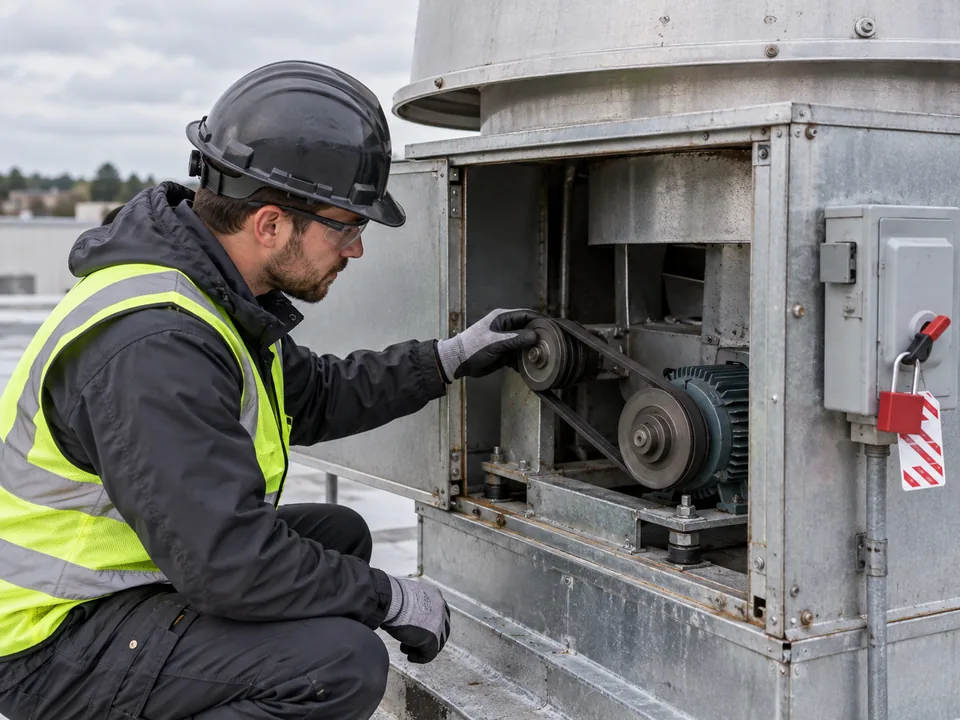
Motor failure or a failing motor
A motor that is dying may still spin, just not fast enough or consistently. A motor that has failed may hum without producing any movement at all. That humming sound with no airflow is one of the clearer signals that the problem is mechanical rather than a cleaning issue. Repeated breaker trips or a burning smell point the same direction.
Makeup air shortages
An exhaust fan can only remove air that is replaced. If the makeup air unit is switched off, undersized, or blocked, the kitchen goes into negative pressure, doors become hard to open, and the hood loses capture even though the fan is running at full speed. Makeup air problems are frequently mistaken for fan faults. Note also that heat recovery ventilators and energy recovery ventilators are not built to handle kitchen grease and particles, which is why they are kept well away from cooking equipment rather than used to solve hood airflow.
Decision Tree: Sorting Cleaning From Mechanical
Work through these steps in order. Stop at any point where the answer points to a mechanical or electrical fault, and do not open the fan housing yourself.
- Confirm the fan is actually running. Listen at the hood, check the fan status indicator or control panel, and look for the rooftop fan from ground level.
- If the fan is silent, humming without movement, tripping a breaker, or producing a burning smell, stop. Treat this as a mechanical or electrical fault and call a qualified contractor.
- If the fan runs normally, remove the filters and check the grease loading. Clean them and run the system again.
- With the filters out, check the flow at the hood opening. Restored airflow means the filter bank was the restriction.
- If flow is still poor, inspect the ductwork, dampers, and the exterior vent cap for blockages or a damper stuck shut.
- Confirm the makeup air unit is running and supplying air to the kitchen.
- If filters, ducts, dampers, vent cap, and makeup air all appear clear and airflow is still weak, the issue is inside the fan assembly or its electrical supply. Hand it to a qualified technician.
The decision tree is a starting point for troubleshooting, not a substitute for site-specific measurements. A qualified technician can confirm static pressure, belt condition, motor amp draw, and airflow against the equipment specifications. Record the findings before selecting a repair path.
Urgent Signs: When to Shut the Kitchen Down
Some symptoms are not maintenance items. Smoke that will not clear from the cooking line, grease smell carrying into the dining room, a hood that captures nothing at all, and heat that keeps climbing are all signs the system is not doing its job while cooking continues. A fan that hums without moving, a burning smell near the fan or control panel, or a breaker that trips repeatedly are electrical warnings.
In those situations, stop cooking, shut the exhaust fan down if it is safe to do so, and arrange service before the kitchen reopens. A commercial exhaust system that cannot move air is both a comfort problem and a fire risk, and continuing to cook under it adds grease to a system that is already struggling. Your local fire code and the authority having jurisdiction in your region set the actual requirements for your system, so confirm specifics with them rather than relying on general guidance.
Where Cleaning Ends and Repair Begins
Cleaning and repair are different trades, and mixing them up wastes money. Use this boundary to decide who to call.
| Task | Normally handled by |
| Filter cleaning, hood, duct, and fan grease removal | Exhaust cleaning specialist |
| Access panel removal and system cleaning documentation | Exhaust cleaning specialist |
| Belt replacement, pulley alignment, bearings, motor replacement | Qualified mechanical contractor |
| Electrical faults, controls, breakers, variable frequency drives | Licensed electrical contractor |
| Makeup air testing, balancing, and commissioning | Mechanical or balancing contractor |
| Compliance inspection and sign-off | Local authority having jurisdiction |
What a Professional Cleaning Visit Covers
A proper restaurant exhaust fan cleaning goes well beyond wiping the hood. The scope typically includes the filters, the hood plenum, the vertical and horizontal duct runs, the rooftop fan, and the grease containment around the fan. Access panels are opened so the interior surfaces can actually be reached and cleaned rather than just the visible faces.
The visit also produces something useful for the decision in this article. When a technician cleans the system and airflow is still weak afterward, the filter, duct, damper, and grease variables have been removed from the list of suspects. What remains is mechanical, and that is a much better starting point for a repair call than a guess.
Keep Belts and Fans on the Same Schedule
Belt condition and grease condition are connected. Heavy grease loading makes a fan work harder, which stresses the drive. Worn belts and misaligned pulleys reduce airflow, which lets more grease settle because the system is not moving air the way it should. Many service providers check belt condition during the same visit as a full system cleaning, since the fan has to be accessed anyway and the two problems often appear together. Treating one without the other usually means a repeat call.
Next Step: Schedule Cleaning and Diagnosis
If suction has dropped gradually and the fan still spins, start with cleaning and a system inspection. If the fan is silent, humming without moving, or tripping breakers, arrange a mechanical or electrical diagnosis first and clean afterward. Either way, the practical move is to get eyes on the system rather than to keep running a kitchen under a hood that is not capturing. Schedule cleaning/diagnosis with a specialist who works on kitchen exhaust systems, and you will know within one visit whether you are looking at grease, a belt, a motor, or an air balance problem.
Frequently Asked Questions
Why is my exhaust fan running but not pulling air?
A running fan only proves the motor is turning. Weak suction usually means the airflow path is blocked somewhere between the hood and the roof, most commonly by grease-loaded filters, a stuck backdraft damper, or a blocked exterior vent cap. If the airflow path is clear, the problem is likely inside the fan assembly, such as a slipping belt or worn pulleys.
Can grease buildup alone cause weak suction?
Yes. Grease buildup restricts the system at every stage. Filters load up first, then ductwork and the fan wheel collect grease, and the fan has to work harder to move less air. A system that pulled well a few months ago and now feels sluggish is a common pattern with heavy grease loading, and cleaning restores airflow.
What is makeup air and why does it matter?
An exhaust fan can only remove air if replacement air is available to come in. That replacement is makeup air, usually supplied by a dedicated unit or intake louvres. If the makeup air unit is off, undersized, or blocked, the kitchen goes into negative pressure, doors get hard to open, and the hood loses capture even though the exhaust fan is running.
Can I fix weak suction myself?
Filter cleaning is the one step most operators can handle safely. Beyond that, opening a rooftop fan, adjusting pulleys, or testing electrical components is work for a qualified technician. If the fan hums without moving, trips a breaker, or smells like burning, power it down and call for service instead of resetting it repeatedly.
How do I know whether to book cleaning or a repair?
If the fan turns normally and airflow has dropped gradually, book cleaning and inspection first. If the fan is silent, humming without movement, tripping breakers, or producing a burning smell, treat it as a mechanical or electrical fault and call a qualified contractor. Cleaning after the repair keeps the system from failing again.