
If the hood is running and the kitchen still smells, the usual causes are grease residue on the filters, inside the hood, in the duct or on the fan, weak airflow that moves some air but not enough, or odours that have nothing to do with the exhaust at all, such as drains, grease traps and waste storage. Check filter condition first, confirm air is actually being pulled into the hood, then follow the path outward to the rooftop fan. The sections below give you a cause checklist, explain how makeup air and non-exhaust sources fit in, and show where cleaning ends and mechanical, inspection or code work begins.
Quick reference: what you notice and what it usually points to
Use this table to match the symptom you are seeing with the part of the system most likely to explain it.
| What you notice | Area to check first | Why it happens | First practical step |
| Smell peaks during service | Filters and hood | Loaded filters restrict airflow and let grease travel into the hood and duct | Inspect and clean or replace filters, check the hood interior |
| Stale grease odour after service | Duct and fan | Grease accumulation on duct walls and fan blades | Look at full system cleaning, not hoods alone |
| Kitchen feels hot and smoky | Airflow path | Weak airflow from loading, blockage or duct leaks | Compare the pull at the hood face with normal |
| Doors pull hard, smell drifts to the dining room | Makeup air | Exhaust cannot pull air that is not being replaced | Have makeup air reviewed by a mechanical contractor |
| Sour smell when the kitchen is cold | Drains and grease trap | Non-exhaust sources such as drains and waste | Clean drains and the trap, check waste storage |
| Smell in the ceiling space or next unit | Duct joints and voids | Exhaust air escaping into ceiling or wall cavities | Inspect joints and the path up to the fan |
Why a running fan does not mean air is moving
A hood fan can run all day and still not move the volume of air your cooking line produces. The motor turns, the blades spin and you hear noise, so everything sounds normal. What matters is airflow through the hood face, up the duct and out through the fan. Grease, dust and debris can slow that path without stopping it, so what you end up with is weak airflow rather than an obvious breakdown. That is why smells build up gradually and why staff often adjust to the problem long before anyone reports it.
The causes behind a restaurant kitchen exhaust smell
Filters that are loaded, damaged or the wrong type
Filters are the first barrier in the system and they matter more than most kitchens treat them. When filters become heavily loaded, they restrict airflow and allow more grease to travel into the hood and ductwork. A grease saturated filter also loses much of its ability to trap the particles that carry odours, so cooking smells pass straight through. Filters that are missing, warped, pushed back into the hood or the wrong type for the cooking underneath them create the same result, with extra grease ending up further downstream where it is much harder to remove.
Grease residue in the hood, duct and fan
Persistent odours are often a symptom of hidden grease buildup. Grease collects on the inside of the hood, on duct walls and on fan blades, and each service adds another thin layer. What you smell is that stale grease odour, noticeable in the dining room even before the kitchen is busy. A dirty duct also leaves less space for air to travel through, so a grease problem usually turns into an airflow problem as well. The fan end of the system is easy to forget because nobody sees it from the kitchen, yet it sits in the same path the odours travel through.
Weak airflow and where it comes from
Loaded filters are the most common cause of reduced pull, and grease inside the duct narrows the passage further. Duct leaks can release exhaust air into ceiling voids or wall cavities instead of pushing it outdoors, which spreads the smell into other parts of the building. On the roof, fans can run well below their intended performance because of buildup, and other fan problems belong to a mechanical trade rather than a cleaning crew. A simple test helps: check the pull at the hood face during service and compare it with what you remember, or with another hood on the same line. A noticeable drop is worth investigating before you spend money on guesswork.
Makeup air, the half of the system kitchens ignore
Exhaust removes air, and something has to replace it. Makeup air is that replacement, whether it arrives through a dedicated unit, a transfer grille, an open door or leaks in the building envelope. When a kitchen cannot pull in enough replacement air, the hood starves and weak airflow follows even though the fan itself is running correctly. Odours then drift outward into the dining room instead of being carried up the duct. Makeup air design, balancing and any changes to it are mechanical work, so if your hoods lose power when exterior doors are closed, that is a conversation for a mechanical contractor.
Drains, grease traps and other non-exhaust causes
Not every smell in a restaurant kitchen comes from the hood. Drains, floor sinks and grease traps can produce a sour, heavy odour that is present even when the cooking line is cold and the exhaust is off. A neglected grease trap can harm air circulation in the kitchen and create a fire hazard at the same time. Waste storage, shared wall and ceiling voids, and neighbouring tenants are other sources that no amount of hood cleaning will fix. One quick way to separate the two: note whether the smell tracks with cooking, which points to the exhaust path, or whether it is there first thing in the morning, which points to drains, waste or something else.
Cause checklist to work through before you book anything
- Filters: clean, correctly sized, sitting flat in the frame and all in place during service?
- Hood interior and plenum: visible grease film or pooled grease above the filters?
- Airflow at the hood face: noticeably weaker or uneven compared with how it used to feel?
- Duct: do you know when the full duct was last cleaned, not just the hood?
- Fan: grease staining on the roof, unusual noise or vibration?
- Makeup air: does airflow drop when exterior doors are closed?
- Ceiling void: any smell in the ceiling space, storage rooms or neighbouring units?
- Drains and grease trap: cleaned on a schedule, with no sour smell when the kitchen is cold?
- Timing: does the smell track with cooking, or is it present when the kitchen is closed?
What a technician checks that you cannot see from the kitchen floor
Some of the answers sit above the ceiling and on the roof. An assessment usually covers grease depth in the hood and duct, the condition of the fan and its blades, how the duct is routed and whether it leaks, whether access panels are present, and whether the airflow you feel at the hood matches the condition of the system. That full path view matters, because the odour is often strongest in one place and worst in another.
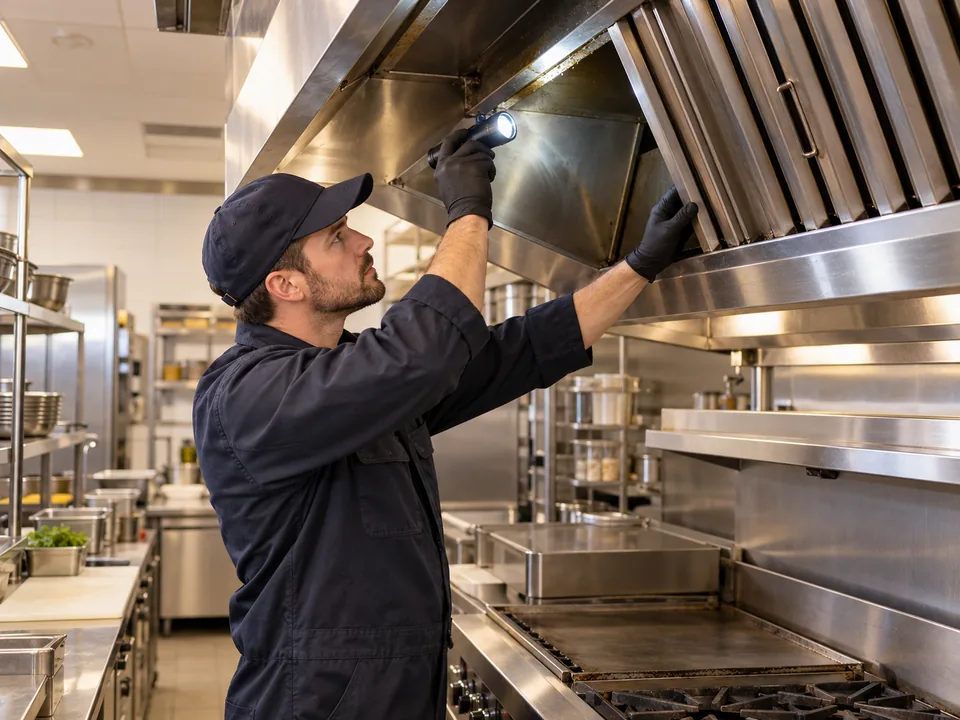
During an inspection, compare filter loading, grease inside accessible hood and duct areas, fan condition, and the direction of airflow. Record where the smell is strongest and when it occurs. These observations help a qualified technician distinguish a cleaning need from an airflow, drainage, or equipment problem; avoid presenting one kitchen’s findings as a rule for every restaurant.
If you want a documented cause instead of a guess, that is the purpose of an assessment, and it also tells you whether the job is a cleaning job, a repair job or both.
Cleaning, inspection and the work that is not cleaning
Cleaning removes the grease that causes the smell and the fire risk. Inspection identifies the condition of the system and what needs attention. Mechanical work, including fan repairs, damper adjustment and makeup air balancing, belongs with a mechanical contractor. Requirements for commercial kitchen exhaust systems come from the fire code that applies to your premises, so confirm the current requirement with your local authority having jurisdiction instead of relying on a general rule of thumb. Keeping those jobs separate prevents you from paying for a cleaning that was never going to solve a mechanical problem.
Professional kitchen exhaust system cleaning for restaurants covers the full path: filters, hood, duct and fan. That scope matters when the smell comes from grease that has travelled past the hood, because hood-only cleaning leaves the source sitting in place.
What cleaning can and cannot do about odours
Cleaning addresses the grease, residue and restriction driving the smell in most cases, and air movement usually improves once the path is clear. It does not guarantee that every odour disappears. Drains, waste storage, neighbouring tenants, cooking styles and makeup air problems all sit outside the exhaust system, and a cleaned hood still only removes what it can pull. Treat cleaning as removing one clear cause and improving the system, not as a switch that turns smells off.
Warning signs that should move this up your list
- Visible grease film inside the hood or on the filters after a normal service
- Smoke hanging in the kitchen instead of being pulled upward
- A fan that sounds different, vibrates, or leaves grease staining on the roof
- Odours noticeable in the dining room or in ceiling spaces
- Smell that gets worse each week despite regular filter washing
How often the system needs attention
Frequency depends on cooking volume, the type of cooking, the fuel used and the condition of the system, and the required interval for your premises is set by the code that applies to it. Check the current requirement with your local authority having jurisdiction, and treat any change in smell, airflow or noise as a reason to inspect sooner. Filter checks are best treated as a daily habit, while the duct and fan sit on a longer cycle.
Frequently Asked Questions
Does a running exhaust hood remove cooking smells?
A hood that is running removes smoke, heat and a share of the grease laden air, but odour control is only partial. If filters are loaded, or grease has built up in the duct and on the fan, air carrying odours stays in the kitchen or drifts into the dining room. Expect improvement from cleaning, not a guarantee.
How often should hood filters be cleaned?
Intervals depend on how much you cook, what you cook and how quickly the filters load. Check them before and after service, and clean or replace them as soon as they look saturated rather than waiting for a set day. The requirement that applies to your premises comes from the code enforced by your local authority having jurisdiction, so confirm it there.
Can a dirty duct cause smells in the dining room?
Yes. Grease inside the duct holds a stale grease odour, and reduced airflow means the system cannot clear the air the cooking line produces. Duct leaks can also push exhaust air into ceiling voids or wall cavities, which is often how a kitchen odour ends up in other parts of the building.
Does exhaust cleaning guarantee the smell will go away?
No, and any company promising that should be treated with caution. Cleaning removes grease, residue and restriction, which are common causes, but drains, grease traps, waste storage, makeup air problems and neighbouring tenants sit outside the exhaust system. An assessment tells you which cause you are dealing with before you commit to work.
If the smell has returned after cleaning, keeps coming back even with regular filter washing, or shows up in areas the hood does not reach, the next step is diagnosis rather than another guess. Arrange an exhaust assessment with Larsa Vent Cleaning so the hood, duct, fan and access points can be checked as one system, and you finish with a clear picture of what needs cleaning and what needs a different trade.