
If the rooftop fan above your kitchen starts grinding, squealing or thumping, treat it as information rather than background noise. A noisy restaurant exhaust fan usually points to one of four areas: grease that has collected unevenly on the fan wheel, a belt that is slipping or tensioned wrong, bearings that have dried out or worn, or a motor and mounting that have worked loose. Some of those get solved by cleaning. Others are mechanical faults that need a qualified technician, and a few are serious enough that you should shut the fan down rather than run it until it fails mid-service.
This article maps common sounds to the parts most likely responsible, explains how vibration and grease imbalance feed each other, and sets out the shutdown conditions that take the decision out of your hands. It also draws the line between what an exhaust cleaning crew can correct and what belongs to a mechanical or electrical contractor.
Quick Reference: Sound, Component and Urgency
Use the table as a first pass only. Sound alone cannot confirm a diagnosis, because the same noise can come from more than one source, and the answer usually requires someone on the roof with the fan isolated.
| What you hear | Likely component | Possible cause | Urgency |
| Grinding or metal scraping | Fan wheel, housing, bearings | Wheel rubbing after cleaning or a motor change, or worn bearings | Shut down and inspect |
| High pitched squeal or whine | Belt, motor shaft bearings | Slipping or glazed belt, or bearings running dry | Shut down and inspect |
| Rattling or clunking | Fixings, motor base, coupling | Loose fasteners and mechanical looseness | Shut down and inspect |
| Rhythmic thump or shake | Fan wheel | Grease imbalance on the wheel | Book cleaning and a balance check |
| Steady roar that grows over months | Wheel, duct, airflow | Grease buildup and reduced airflow | Schedule service |
Why a Noisy Restaurant Exhaust Fan Is Worth Diagnosing Early
An exhaust fan is a rotating assembly. A wheel spins inside a housing, driven by a belt from a motor, with the motor sitting on a base and connected through a shaft or coupling. Each of those interfaces can generate noise, and the noise is rarely random. It reflects a physical change: something has gone out of balance, out of alignment or out of lubrication.
The reason operators in BC should not let it run is the compounding effect. Vibration from an unbalanced wheel travels back through the shaft and starts to influence the motor bearings. Once vibration is high enough, fixings begin to loosen, and misalignment magnifies the vibration further. A problem that could have been a cleaning visit turns into parts, downtime and a service call during dinner service.
Matching the Sound to a Possible Cause
The descriptions below are starting points for a conversation with a technician, not a diagnosis you can complete from the kitchen line. Two different faults can produce almost identical noise, and only an inspection with the fan off and isolated will separate them.
Grinding or metal on metal
Grinding suggests moving parts in contact that should not be touching. A common pattern appears after maintenance, a motor replacement or a cleaning, when the fan wheel ends up rubbing and the noise shows up right after the work. In other cases, grinding tracks back to worn bearings allowing the shaft to move, and continuing to run it wears the contact surfaces.
Squealing or a high pitched whine
A squeal usually comes from the belt drive or from the motor. A belt can slip, glaze or sit at the wrong tension, and operators who have tried everything report greasing bearings and tightening and loosening belts without eliminating the whine. On the motor side, a noisy motor often indicates that the shaft bearings are worn. Some older, larger motors have oil spouts and can be lubricated, while many modern sealed motors cannot.
Rattling or clunking
Rattling points to hardware rather than rotating balance. Loose panels, guards, fasteners and a motor base that is not tight all produce this kind of sound, and vibration is what loosens them in the first place. This is the category where the fix can be simple, but only if it is caught before a fastener or a mount fails completely.
Thumping, humming or rhythmic vibration
A repeating thump that matches the rotation speed is a strong hint of imbalance. Grease does not always build up evenly, and an uneven layer on a fan wheel changes its balance. The fan then vibrates, the vibration transfers into the bearings, and the cycle deepens. Grease imbalance is one of the few causes on this list that cleaning directly addresses.
A roar that never changes
Some fans are loud all the time, and the volume creeps up so slowly that nobody notices. That pattern fits progressive grease buildup, restricted airflow or a system that was never balanced for how the kitchen now operates. It is a maintenance signal rather than an emergency, but it rarely improves on its own.
Vibration, Grease Imbalance and the Fan Wheel
Vibration deserves its own section because it is both a symptom and a cause. The fan wheel is the heaviest rotating part in the assembly, and grease adds weight to it. When that weight is unevenly distributed, the wheel is out of balance, and every rotation pushes the shaft slightly off centre. That force has to go somewhere: into the bearings, the belt, the motor mounts and the roof structure.
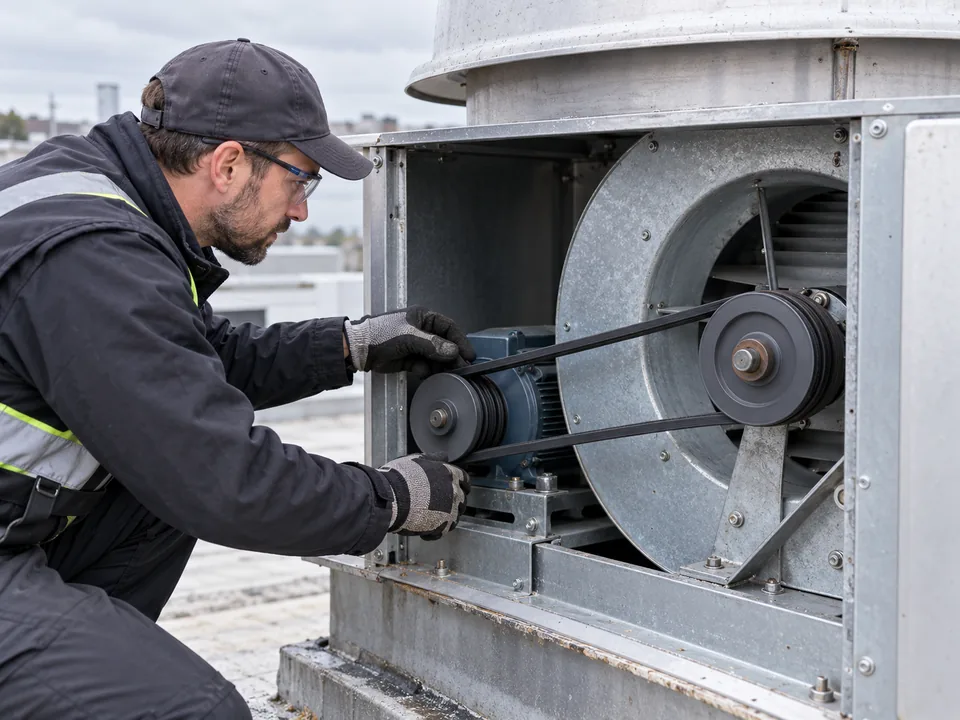
In documented cases of exhaust fan unbalance, the vibration was strong enough to begin influencing the motor bearings and to loosen fixings. That is the mechanism behind many “the fan got noisy and then something broke” stories. Cleaning restores balance only when the wheel is cleaned properly and the assembly is checked afterwards, which is why a cleaning visit and a mechanical inspection are not the same thing.
Belt, Bearings and Motor: What Each One Tells You
These three components account for most mechanical complaints, and each behaves differently as it wears.
- Belt: holds tension and transfers drive. Slipping, glazing, wrong tension and wrong size all change both noise and airflow.
- Bearings: support the shaft. Dry or worn bearings produce whine, rumble or grinding, and they absorb the punishment from any imbalance upstream.
- Motor: provides the drive and sits on a base that can loosen. Motor noise can also be a symptom of everything the fan is doing to it.
Notice the direction of the relationship. A dirty wheel can damage a motor, and a loose base can make a healthy belt noisy. Replacing a part without addressing balance and alignment often produces the same complaint a few weeks later.
When to Shut the Fan Down
Stop the fan and keep it stopped if you hear grinding or metal contact, if you see or feel heavy vibration, if the fan is leaking grease, or if a belt has come off. Reports of fans leaking profuse amounts of grease point to a unit that needs repair, not a wipe down. Shutdown is also the right call when a fan is overheating, tripping, or making a noise that changed suddenly rather than gradually.
Shutting down a kitchen exhaust fan affects cooking operations and may affect whether you can keep cooking, depending on your system and your local requirements. Confirm your obligations with your local fire authority or your mechanical contractor rather than relying on a general rule. What you should not do is keep running a fan that is grinding or shaking in the hope that it lasts until Monday.
What Cleaning Fixes and What It Does Not
A professional service addresses the grease side of the problem. restaurant exhaust fan cleaning removes accumulated grease from the fan, the wheel and the surrounding system, which is what brings an unbalanced wheel back toward balance and reduces the fire load in the duct. What it does not do is replace bearings, realign a coupling, set belt tension or repair a failing motor.
That boundary matters for how you spend money. A qualified cleaning crew can identify what they see and report it, while a mechanical or electrical contractor carries out the repair. If the noise is mechanical rather than grease related, cleaning alone will not quiet the fan, and the report from the cleaning visit becomes the evidence you need to book the right trade.
Audio and Video Evidence
A short recording of the fan is often more useful than a description over the phone, so share audio or video of the noise when booking. Record from a safe location without approaching or opening the fan, and note when and where the sound was captured.
Book an Inspection Before Failure
The next step is straightforward. Note when the noise started, record it if you can, and describe whether it is constant or tied to a change such as a recent cleaning, a motor replacement or a new belt. That context lets the right trade arrive prepared instead of guessing. Book an inspection before failure, while the fix is still a service visit rather than an emergency repair in the middle of a busy service.
Frequently Asked Questions
Why is my kitchen exhaust fan suddenly so loud?
A sudden change usually means something moved. Loud grinding, rattling or squealing can indicate a problem with the motor, loose components or worn bearings, and it can also appear right after maintenance, a motor replacement or a cleaning if the wheel is left rubbing or out of balance. Sudden noise deserves an inspection rather than waiting.
Can a dirty fan wheel cause vibration?
Yes. Grease does not always collect evenly, so the wheel becomes heavier on one side and loses balance. That imbalance produces vibration, and sustained vibration can start to influence the motor bearings and loosen fixings. Cleaning the wheel and checking the assembly afterwards is the usual way to remove that particular cause.
Is it safe to keep running a fan that is squealing?
A squeal usually comes from the belt drive or from worn motor shaft bearings. Continuing to run it accelerates wear on parts that are already struggling, and if a belt fails the fan stops moving air. Shut the fan down if the noise comes with heavy vibration, grinding or grease leaking from the unit, then arrange an inspection.
How often should an exhaust fan be inspected?
Inspection frequency depends on your cooking volume, fuel type and the requirements that apply to your premises, so confirm the schedule with your local fire authority. Between scheduled visits, treat any new grinding, rattling, squealing or vibration as a reason to book an inspection early. A short recording of the sound helps the technician prepare.